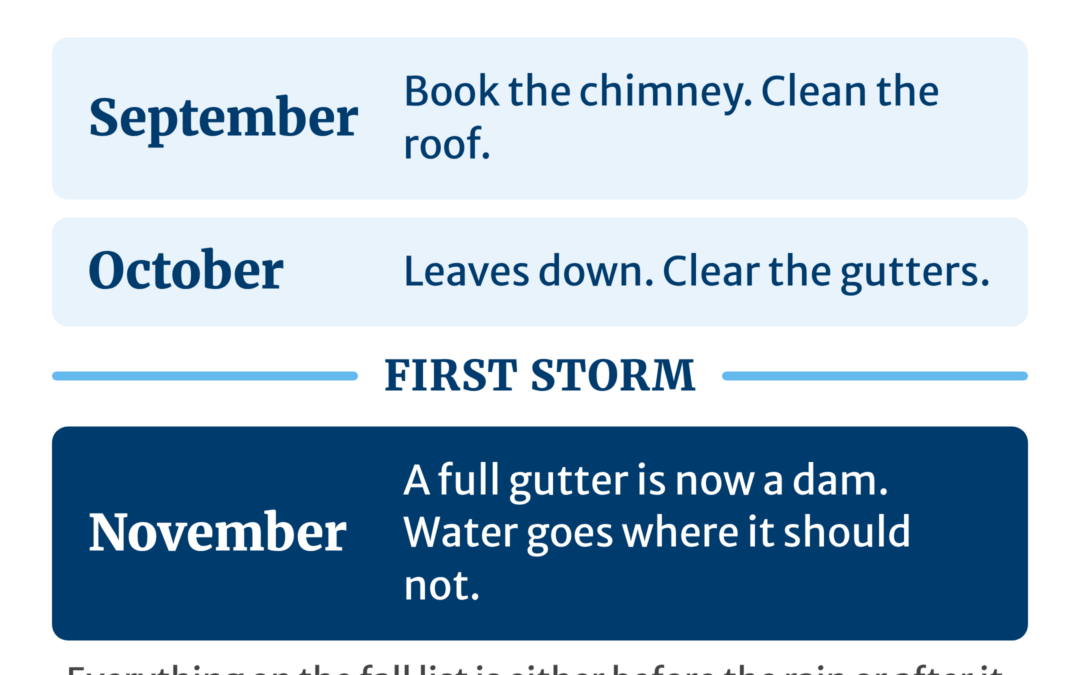
The busiest month for gutter calls is November. By then the first real storm has usually already come through, which means the water has already found the clog, backed up over the edge, and run down the side of the house. The call is a reaction to a problem rather than a way of avoiding one. What follows is an exterior home maintenance calendar for Greater Sacramento built to close that gap — organized around what actually happens to buildings in this valley rather than around the months on a generic checklist.
That same gap shows up almost everywhere. Chimney calls cluster in November too, mostly from people who want a fire that evening. Roof cleaning calls peak in March, after a wet winter has already given moss three months to take hold. Solar panel calls arrive in July, near the end of the sunniest stretch of the year rather than ahead of it.
None of that is a criticism. It is simply how maintenance works when nothing looks wrong yet: you notice a problem, then you deal with it. Working ahead of that gap takes less effort than reacting to it does.
Why a Sacramento home maintenance schedule looks different
Most home maintenance schedules are written for a climate with rain spread through the year and a hard freeze in winter. Greater Sacramento has neither. We get a long dry stretch through the warm months and then concentrate nearly all the year’s rain into the cool ones, which the National Weather Service describes as a distinct rainy season rather than year-round precipitation. The local climate record makes the pattern plain: months on end with essentially nothing, then everything at once.
That single fact reorganizes the whole year. Four things drive most of what needs cleaning around a building here:
- Tree cover. Mature oaks, sycamores, and conifers shed on their own schedule, and that schedule sets when gutters, roofs, and patios need attention.
- Irrigation water. Sprinklers run for months without rain to rinse anything off, so whatever is in the water ends up on the glass, the siding, and the panels.
- Fire season. Fine ash travels a long way and settles into gutters, on roofs, and across every horizontal surface.
- A damp, low-sun winter. Short days and long fog make north-facing surfaces stay wet for weeks, which is exactly what moss and algae need.
Work with those four and the timing sorts itself out. Ignore them and you end up on the November schedule, cleaning things after they have already caused a problem.
Spring: March through May
Spring is the messiest air of the year. Oaks drop catkins and pollen in volume, and the yellow-green film that lands on everything is not dust that will blow off. It sticks, and once it gets wet it stains.
This is also when the sprinklers come back on. The first few runs of the season are worth standing outside and watching, because that is when you find out which heads are throwing water onto windows, siding, or panels. A head that has drifted a few degrees over the winter will spend the next six months spraying the house instead of the lawn, and moving it takes about a minute.
Most people get spring right. Window cleaning and pressure washing calls peak in May, and house washing in June, which is sensible timing once the pollen has finished falling.
The thing that gets missed is the roof. Roof cleaning calls peak in March, and that is a season too late. People are looking at moss that grew over the winter and deciding to deal with it now. Cleaning it in spring works, but it means the growth already spent a full wet season on the shingles. The better move is the previous fall, which is covered further down.
Summer: June through August
Summer is dry, dusty, and hard on anything the sprinklers touch. With no rain for months, irrigation water is the only water most surfaces see, and it leaves behind whatever it was carrying.
Whether that shows up as spotting depends almost entirely on where your water comes from, and it varies a lot across this region. Communities supplied by rivers and lakes get very little mineral spotting. Folsom is the clearest example, drawing all of its water from Folsom Lake, and Granite Bay, Orangevale, and West Sacramento are in similar shape. Communities supplied mainly by wells see noticeably more, because groundwater picks up minerals as it moves through rock and soil. Parts of south Sacramento and Arden-Arcade sit at the heavier end of that range.
If you are on well water, the fix is prevention rather than removal. Keep sprinkler spray off the glass and off the panels, and clean on a regular schedule so deposits never get the chance to bake on through a whole summer. Spots that sit for several seasons can etch permanently, and at that point no cleaning brings them back.
Solar panel cleaning calls peak in July, which is later than ideal. Panels produce hardest through the long days of early summer, so cleaning them before that stretch rather than at the end of it is where the benefit sits.
This is also the season the hardscape gets the most use. Patios and driveways are worth cleaning when you are actually using them, not in November when nobody is outside.
Fall: September through November
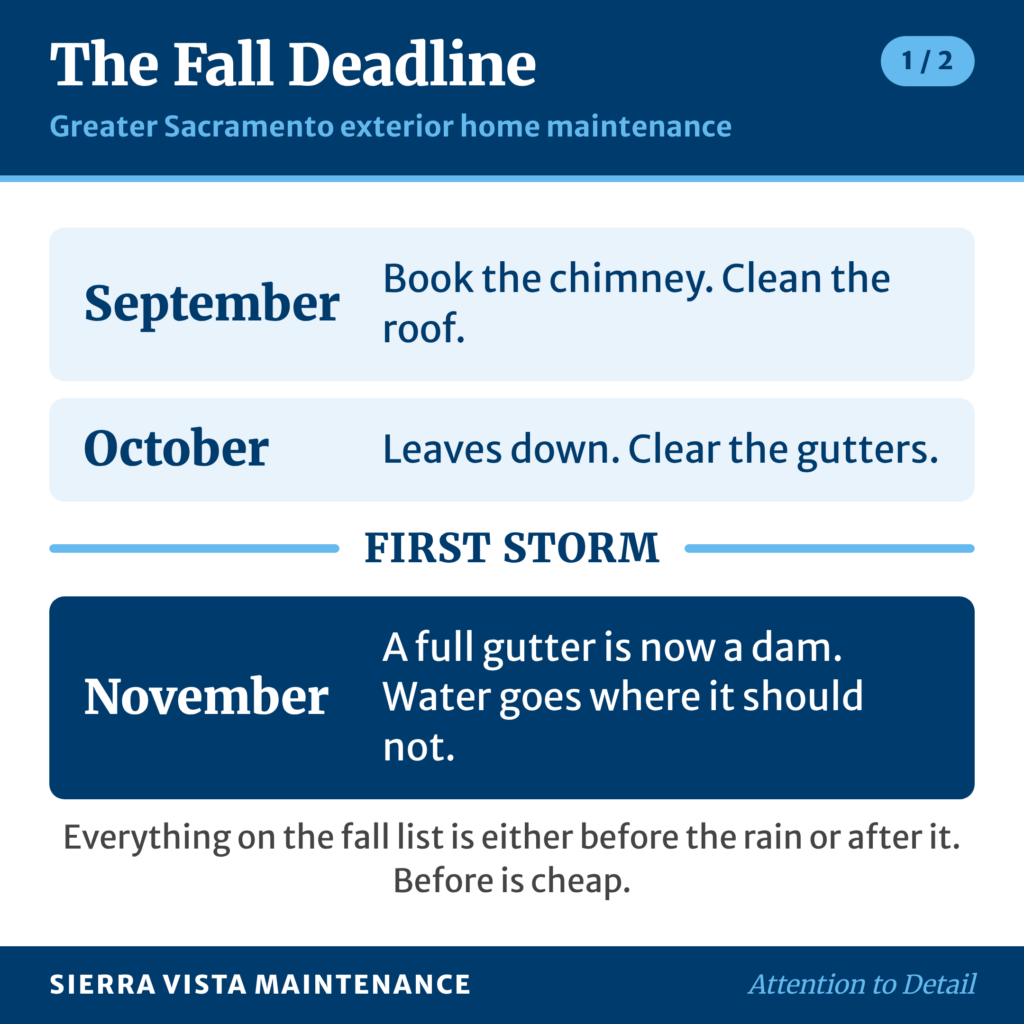
Fall is the only part of this calendar with a real deadline, and everything in it is organized around one question: has the first storm come through yet?
Before that storm, a gutter full of dry leaves is a nuisance. After it, the same gutter is a dam. Water backs up under the roof edge, runs down the fascia, and finds its way into places that are expensive to dry out. That is the whole reason November is the wrong month to call about gutter cleaning and it is the single most common timing mistake in the region.
The window you want is after the bulk of the leaf drop but before the first significant rain. That is usually a matter of weeks, not months, and it moves year to year. Watching your own trees is more reliable than watching the calendar: when the canopy is mostly bare, the gutters are ready to clear. If your property has heavy tree cover, you may need two passes, one mid-drop and one after.
Fire season overlaps this window. Fine ash settles into gutters and across roofs, and mixed with the first rain it turns into a paste that is much harder to clear than dry debris. Clearing before the rain rather than after is the difference between a routine visit and a difficult one.
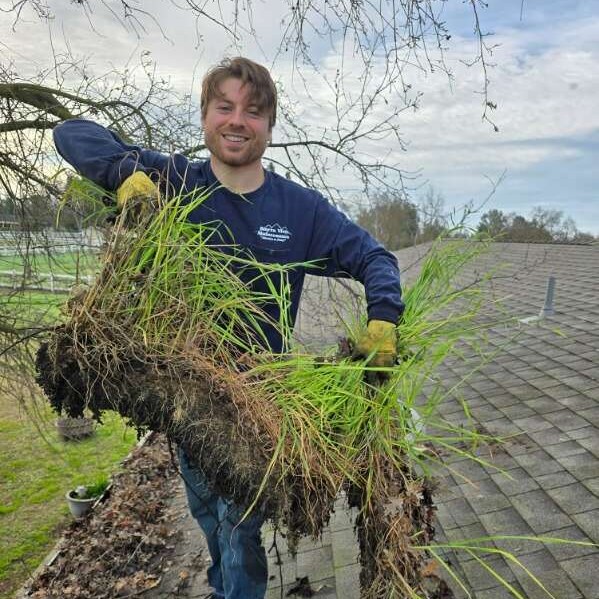
Fall is also the right time for roof cleaning, for the reason described earlier. Moss and algae need moisture, and the wet season is what feeds them. Going into winter with a clean roof means the growth starts from nothing instead of picking up where it left off.
Chimney cleaning has the sharpest timing gap of anything measured. Calls concentrate in November, and they come from people who have decided to have a fire that night and want the chimney checked first. Booking is tight, and the answer is often not tonight. Late summer or early fall means you are calling when nobody else is.
Winter: December through February
Winter here is not cold so much as dim and damp. The sun sits low, fog settles in for days, and anything facing north can stay wet for weeks at a stretch. That is why the green growth on a house is almost never evenly distributed. The north wall has it and the south wall does not, and the same is true of roofs, fences, and the shaded end of a patio.
That growth is also what makes hardscape slick. A patio under a mature oak can be genuinely unsafe by January, and the film responsible is biological rather than dirt, which is why hosing it off does not work for long.
Winter is the quiet season for outdoor calls, which makes it the sensible time for work that happens under a roof. Air duct cleaning is easier to schedule now, and the heating system is running enough that you would notice the difference. Dryer vent cleaning matters more in winter than any other season, because nothing dries outside and the machine runs harder and longer than it does in July.
The foothills run ahead of the valley floor
A calendar built for Elk Grove does not quite fit Auburn, and the difference is bigger than most people expect for two places forty minutes apart.
Higher ground gets rain earlier in the fall and more of it. It also carries denser and more varied tree cover, with conifers alongside the oaks, which means more debris and a longer shedding season rather than one concentrated drop. Cooler air holds moisture on surfaces longer, so moss and algae get a stronger start and hold on further into spring.
The practical effect is that properties in Auburn, Placerville, Cameron Park, and the higher parts of El Dorado Hills should run the whole fall sequence earlier than properties in Natomas, Elk Grove, or West Sacramento. Gutters, roof, and chimney all move up.
The valley floor has its own quirk. Tule fog does not wet surfaces the way rain does, but it keeps them from ever fully drying, and a north-facing wall in the flats can stay damp for most of December and January without a drop falling on it. Different mechanism, similar result.
How to actually use this
Do not try to run the whole calendar. Almost nobody needs every item on it, and a schedule that demands twelve things a year gets abandoned by March.
Pick the two or three that match your property. A house under heavy oaks lives and dies by the fall gutter window. A place on well water with south-facing glass should think about sprinklers and spotting first. A foothill property with a wood stove needs the chimney handled in September, not November. Everything else is optional.
The one item worth treating as non-negotiable is clearing the gutters before the first storm. It is cheap, it takes an hour, and skipping it causes more expensive damage than everything else on this list combined.
Sierra Vista Maintenance works across the Greater Sacramento region, from the valley floor out into the foothills, and the timing above reflects what the calling pattern actually looks like across those areas year after year.
Your exterior home maintenance calendar, month by month
If you want the short version, here it is. Nothing in this table is mandatory. It shows what is going on outside in a given month and what tends to be worth booking then, so you can find your own two or three items and ignore the rest.
| Month | What is happening outside | Worth scheduling |
|---|---|---|
| January | Fog and low sun keep north-facing walls damp for weeks. Heater and dryer running hard. | Air ducts, dryer vent, interior windows |
| February | Moss and algae at their strongest. Shaded patios and walkways get slick. | Patio, roof assessment |
| March | Oaks start dropping catkins. Winter growth on the roof is now obvious. | Roof cleaning, if it was skipped in fall |
| April | Peak pollen. Sprinklers come back on for the season. | Air ducts, and walk the yard to check sprinkler spray |
| May | Pollen finishing. The dry stretch begins. | Windows, pressure washing |
| June | Dry and dusty. Irrigation is the only water most surfaces see. | House wash, solar panels |
| July | Longest days and highest solar output. Patios and driveways in heavy use. | Patio, driveway |
| August | Dust building up. Fire season underway. | Solar panels, windows if you are on well water |
| September | Fine ash settling. Leaf drop starting in the foothills. | Chimney (book now), roof cleaning |
| October | Main leaf drop across the valley. First storms possible. | Gutters, gutter guards, roof |
| November | First real storms usually arrive. Fireplaces come on. | Gutters, if they are still full |
| December | Wet season underway. Short, damp days. | Air ducts, dryer vent |
The two rows that matter most are September and October. Almost everything else on this calendar can slip a month without consequence. Those two cannot, because they sit in front of the rain.
Which parts of this actually apply to you?
Most of this calendar will not apply to your property. Five questions narrow it down to the two or three items that will.
- Do mature trees hang over your roof? If yes, the fall gutter window is the most important thing on this page, and heavy canopy usually means two passes rather than one. If your roof is in the open, gutters become a once-a-year item you can be relaxed about.
- Does your water come from wells or from a river or lake? Well water leaves mineral deposits on glass, siding, and solar panels; river and lake water leaves very little. If you are on wells, watch where the sprinklers spray and clean on a schedule so deposits never bake on. If you are not, you can mostly ignore the spotting question.
- Do you have walls, roof sections, or paving that face north or sit in shade? Those are the surfaces that stay damp through winter and grow green. South-facing surfaces on the same property often need nothing at all. This is why one wall looks bad while the rest of the house looks fine.
- Do you burn wood? Then September is your month. Not November, when everyone else calls and scheduling gets tight.
- Do you have solar? Clean before the long days of early summer rather than at the end of them, so the panels are clear through the stretch when they produce most.
One or two yeses means a short list and a light year. Four or five means the full calendar is worth spreading out deliberately rather than trying to handle in one weekend.
Which of these can you do yourself?
Some of this is reasonable to handle on a Saturday. Some of it is how people end up in the emergency room, and the line between them is not really about skill.
- Reasonable to do yourself: ground-floor windows, patios and walkways, driveways, and hosing dust off anything you can reach while standing on the ground. A consumer pressure washer handles concrete adequately. The work is slower than a professional job and the results are less even, but nothing about it is dangerous and nothing is easy to ruin.
- Worth thinking twice about: gutters on a single-story house. Doable from a ladder if you are steady on one and the ground underneath is level and firm. The risk is not the height, it is that gutter work involves reaching sideways while holding something, and that is exactly how ladders go over. If you do it, move the ladder more often than feels necessary.
- Not worth doing yourself: anything on a roof, anything above single-story, anything inside a chimney flue, and dryer vent runs that go up through a wall or across an attic.
Roofs are the clearest case. Walking on wet or mossy composition shingle is genuinely treacherous, and the damage you can do by walking wrong on a hot day — cracking shingles, dislodging granules — often costs more than the cleaning would have. Chimneys are similar for a different reason: the point of the work is to remove creosote from inside a flue, and a partial job leaves you thinking the problem is handled when it is not.

There is also a category of work where the risk is not to you but to the building. Pressure washing siding, stucco, and older paint can drive water where it does not belong or strip the surface outright, and that damage shows up months later rather than immediately.
The honest summary: if you can do it with both feet on the ground, it is a fair DIY project. If it requires a ladder, a roof, or getting inside a flue, the cost of hiring it out is small compared to what going wrong costs.
Common questions about maintenance timing
How often should gutters be cleaned in the Sacramento area?
For most properties, once a year is enough, timed after the bulk of the leaf drop and before the first significant rain. Properties under heavy tree cover, especially mature oaks or conifers, often need two passes in the fall rather than one. The number of trees overhanging the roof matters far more than the size of the house.
When is the best time to clean a roof here?
Fall, before the wet season starts. Moss and algae need sustained moisture, so a roof that goes into winter clean starts the wet months from nothing. Most people call in March instead, after a winter of growth is already visible. Spring cleaning still works, it just means the growth got a full season first.
Do windows need cleaning more than once a year?
It depends on your water and your sprinklers more than on the calendar. If you are on well water and irrigation spray reaches the glass, twice a year keeps deposits from setting in. If your water comes from a river or lake supply and no sprinkler hits the windows, once a year is usually fine.
When should a chimney be cleaned before fireplace season?
Late summer or early fall, well before the first cold night. Calls concentrate in November, which is the hardest time to get scheduled and the least useful time to find out something needs attention. Booking in September means the answer arrives before you need the fireplace, not after.
Does the maintenance schedule change in the foothills?
Yes. Auburn, Placerville, Cameron Park, and the higher parts of El Dorado Hills get rain earlier in the fall, carry denser and more mixed tree cover, and stay damp longer than the valley floor. The whole fall sequence should run earlier there, and moss tends to be more persistent through spring.


