Chimney Cleaning in Placerville and El Dorado County
Local Context
Placerville and the surrounding El Dorado County communities — Shingle Springs, Diamond Springs, and Rescue among them — sit in the deepest foothill country we serve, and it shows in how people heat their homes. This is higher, colder ground than the valley floor, and for a great many households here a wood-burning fireplace or stove is not a weekend luxury but the main way the house stays warm from fall through early spring.
The climate drives everything. Winters up here are genuinely cold and long, with a burning season that can run from October well into April, and at the higher elevations a wet, icy roof is a real part of the season rather than a rare event. That means fireplaces get worked hard for months at a stretch, and the creosote that builds up inside a hard-used flue accumulates far faster than it would in an occasionally lit valley home.
The forested setting adds to it. Pines and oaks crowd many of these properties and drop needles and debris onto roofs and around chimneys through much of the year, so there is plant litter outside the flue as well as creosote within.
For homes that lean on wood for heat, an annual pre-season cleaning is not really optional — it is how you start a long, cold burning season safely.
How We Help Placerville and El Dorado County Homes & Businesses
Sierra Vista Maintenance handles chimney cleaning for wood-burning and gas/wood combination fireplaces and stoves throughout Placerville, Shingle Springs, Diamond Springs, and Rescue, brushing the flue and firebox clear of soot and creosote and vacuuming out the ash. A gas-only fireplace has nothing to sweep, so you can leave it be. We are cleaners rather than masons: we do not perform certified inspections or repair caps, crowns, liners, or dampers, but we look them over, photograph anything worn, and point you to the right specialist. And on wet or icy foothill roofs, we simply reschedule for a safer day.
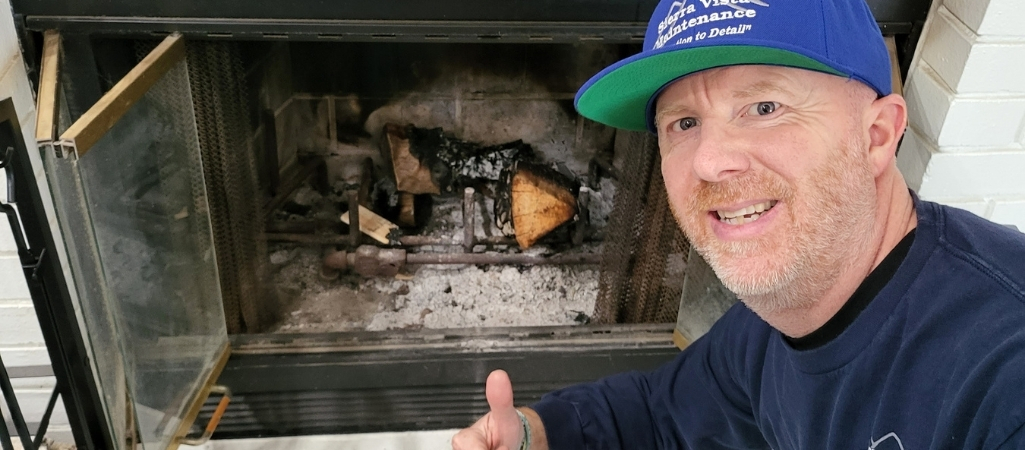
Every visit is contained. We seal the firebox, lay drop cloths, and keep an ash vacuum running the whole time so the soot stays in the fireplace, not on your floors. After a look with a light and mirror, a rotary brush sized to the flue works the creosote loose from the top down — and because so many homes here burn hard, that buildup is often heavier than what we find lower down the hill. Then we clean out the fireplace, vacuum the hearth, and send before-and-after photos the same day.
For occasional-use fireplaces, one pre-season chimney sweep each fall is enough. For the many El Dorado County homes that burn wood as primary heat, our chimney cleaning services often mean that fall cleaning plus a mid-season check, since a flue running nightly can be due again before winter is over.
Wood stoves and inserts are common up here, and they get the same careful chimney and fireplace cleaning as an open masonry hearth — brushed thoroughly, checked, and cleared. Whatever you burn in, the goal of our chimney cleaning service is a flue that draws cleanly and a fireplace that is safe to run all season.
Because the timing matters so much at this elevation, we encourage booking the fall cleaning early, before the first snow makes roofs unsafe to work. You can also read more about our chimney cleaning services across Greater Sacramento.
What Makes Chimney Cleaning in Placerville and El Dorado County Different
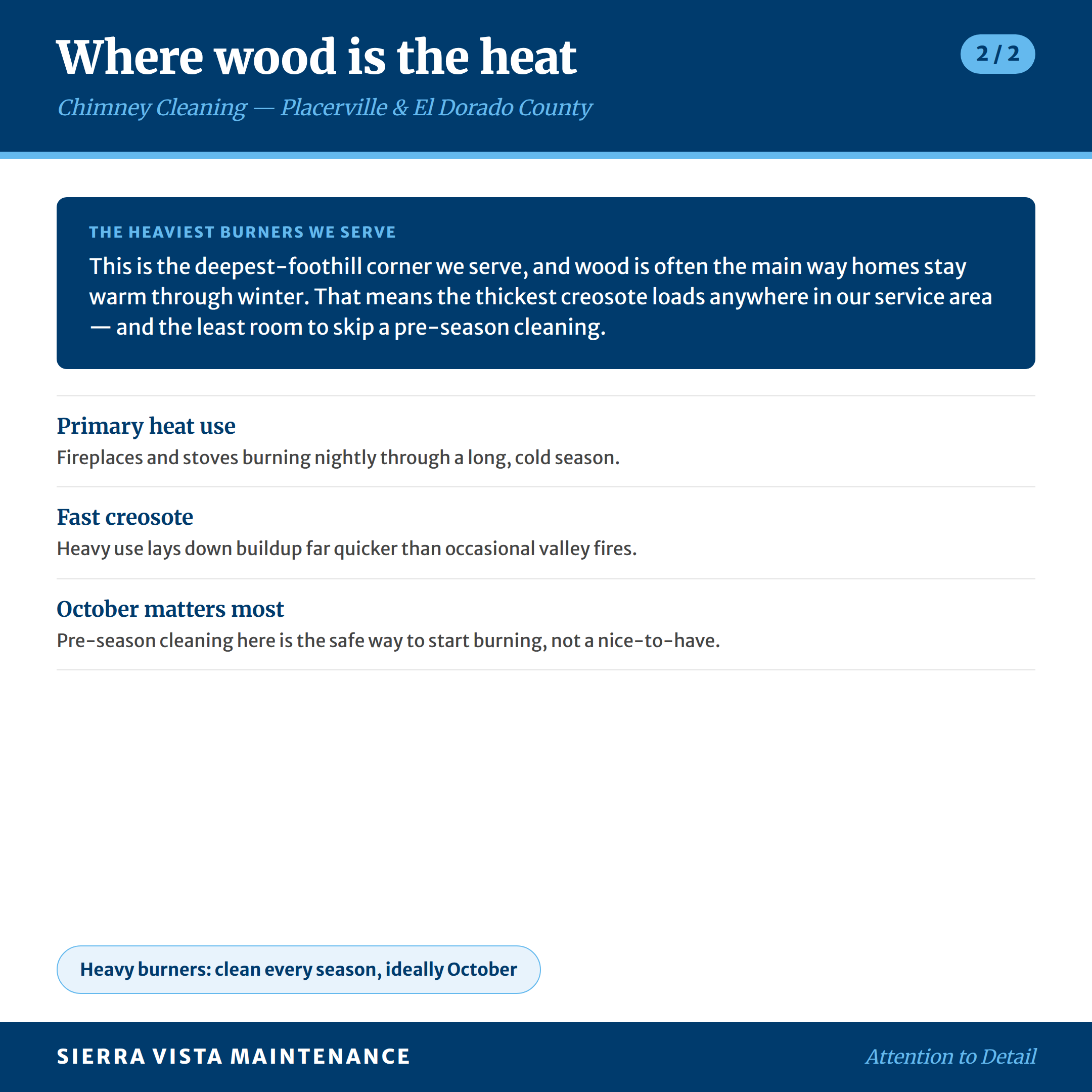
What makes chimney cleaning in Placerville and El Dorado County distinctive is the mountain climate. This is the coldest, highest ground in our service area, and the burning season here is the longest we see — where a valley home might light a dozen fires all winter, a Placerville household may burn every single night from October into April.
That long, hard-use season changes the whole calculation. Creosote is a function of how much you burn, and a flue that runs nightly for six months lays it down quickly, which is why homes up here often need more frequent attention than anywhere else we work. It is also why the pre-season timing is so important: you want the chimney clean and clear before the first fire of a season that will not let up for months.
The elevation matters for safety and scheduling, too. At the higher end of the county, roofs turn wet, frosty, or snow-covered early and stay that way, and we will not work an icy roof. Booking the cleaning in early fall, ahead of the weather, is the difference between getting it done on schedule and waiting out a storm — one more reason the mountain setting shapes how chimney cleaning works here.
Common Chimney Cleaning Issues We See in Placerville and El Dorado County
Heavy, Glazed Creosote
The single most common thing we find up here is creosote left to build across a hard-burning season until it hardens into a glazed layer. That is the toughest and most dangerous form to remove, and it is exactly what an annual fireplace cleaning prevents by keeping the buildup soft and manageable.
Signs a Flue Is Overdue
A strong, tarry smell, poor draft, or a fireplace that smokes into the room often means creosote has gotten ahead of you. During a chimney sweep we clear that buildup and tell you plainly how heavy it was, so you can judge whether your burning habits call for a mid-season visit.
Wood Stoves and Inserts
Many El Dorado County homes heat with a wood stove or insert rather than an open hearth. These need their own thorough cleaning — the connector pipe and flue included — and we handle them as part of our chimney cleaning services just as we would a masonry chimney.
Idle-Season Nesting
Even hard-working chimneys sit idle through the warm months, and a cracked cap invites birds and squirrels into the flue. Part of why we clean out the fireplace before the first fall fire is to be sure nothing has moved in over the summer.
Where Wood Is the Heat: Why the Pre-Season Sweep Isn’t Optional
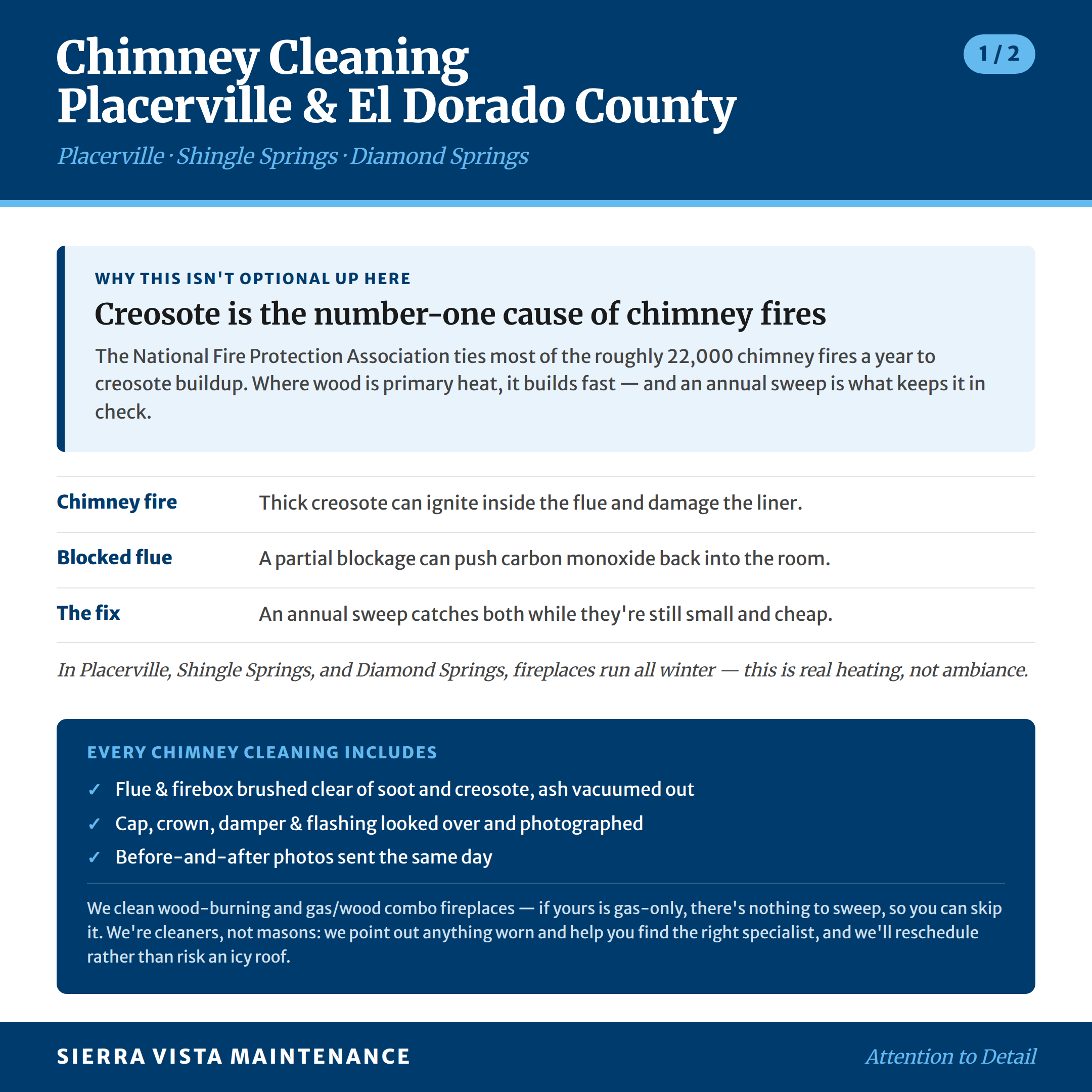
For homes that burn wood as their primary heat — and there are many in Placerville, Shingle Springs, and Diamond Springs — chimney cleaning stops being routine upkeep and becomes a genuine safety matter. The reason is creosote. The National Fire Protection Association ties the large majority of the roughly 22,000 chimney fires reported in a typical year to creosote buildup, and creosote is precisely what a season of nightly fires produces.
The mechanism is simple and worth understanding. Every wood fire coats the flue with a little more creosote; burn night after night through a long foothill winter, and that coating thickens into a fuel source of its own, lining the very passage that is supposed to carry heat safely out of the house. A partially blocked flue is a second hazard, since it can push carbon monoxide back into the living space instead of venting it away.
An annual pre-season sweep is what keeps both risks in check, which is why up here it is not something to put off. Clearing the flue in early fall means the heavy heating season starts with a clean passage, and for the hardest burners a mid-winter check keeps it that way through to spring.
None of this is meant to alarm — it is simply the reality of heating with wood at this elevation. Homes that keep to a yearly rhythm rarely have trouble; the risk lives with the flue that goes several seasons untouched. For El Dorado County households that rely on the fireplace to stay warm, that annual cleaning is one of the most straightforward pieces of home safety there is.
It is worth adding that this is not fear-based upkeep but simple stewardship of a working system. A household that keeps its flue swept each fall runs its fireplace with confidence all winter; the trouble almost always traces back to a chimney that quietly went several seasons without a look while the fires kept burning. In a place where the fireplace is often the furnace, that yearly habit is as basic as changing a smoke-detector battery.
I heat my home with wood all winter — how often should the chimney be cleaned?
At least once a year before the season starts, and often a mid-season check on top of that. A flue that runs nightly for months builds creosote quickly, so primary-heat homes in El Dorado County usually need more frequent attention than an occasionally used valley fireplace.
How do I know if my chimney has dangerous creosote buildup?
Warning signs include a strong tarry odor, poor draft, or smoke coming back into the room. You cannot always tell from inside, though, which is why an annual sweep matters. We clear the buildup and tell you how heavy it was so you can judge your cadence.
Do you clean wood stoves and inserts, not just open fireplaces?
Yes. Wood stoves and inserts are common up here and we clean them thoroughly, connector pipe and flue included, the same way we would a masonry chimney. If you burn wood in it, it builds creosote and needs sweeping.
Can you still clean my chimney in winter if there’s snow or ice?
We will not work a wet, frosty, or snow-covered roof — it is not safe. That is why we encourage booking the fall cleaning early, before the weather sets in. If a mid-season visit is needed, we wait for a clear, dry day to do it safely.
Can you repair a damaged flue or cap?
No — we clean rather than repair. We do not fix liners, caps, crowns, or dampers. We do check them on every visit, photograph anything worn, and explain what we see so you can bring in the right specialist.
Request an Estimate
In most cases, we deliver same-day or next-day quotes after we speak with you on the phone or after you complete an estimate request online.