Dryer Vent Cleaning in the Auburn Foothills

Local Context
The Auburn foothills rise along I-80 east of Roseville — Auburn, Newcastle, Penryn, Loomis, Bowman, and Meadow Vista — in oak and pine woodland on larger, often sloped lots. The housing runs older and more custom than the valley: ranch homes, cabin-style builds, and properties like those around Lake of the Pines, many on an acre or more.
Two things shape dryer vent work here. Local requests skew toward wall terminations and toward larger homes with dedicated laundry rooms, so tight working spaces are rare — but locating the exit can be its own challenge. One Auburn homeowner simply couldn’t find their exterior vent. And the whole area sits in elevated wildfire country, which changes what a clogged, lint-packed vent means.
These are homes where the laundry room is usually roomy but the vent run can be long and the exterior hood easy to overlook on a wooded, sloped lot. Much of the surrounding terrain is mapped as high or very-high fire hazard severity, so a clean, well-sealed vent is part of the same picture as defensible space.
How We Help Auburn Foothills Homes & Businesses
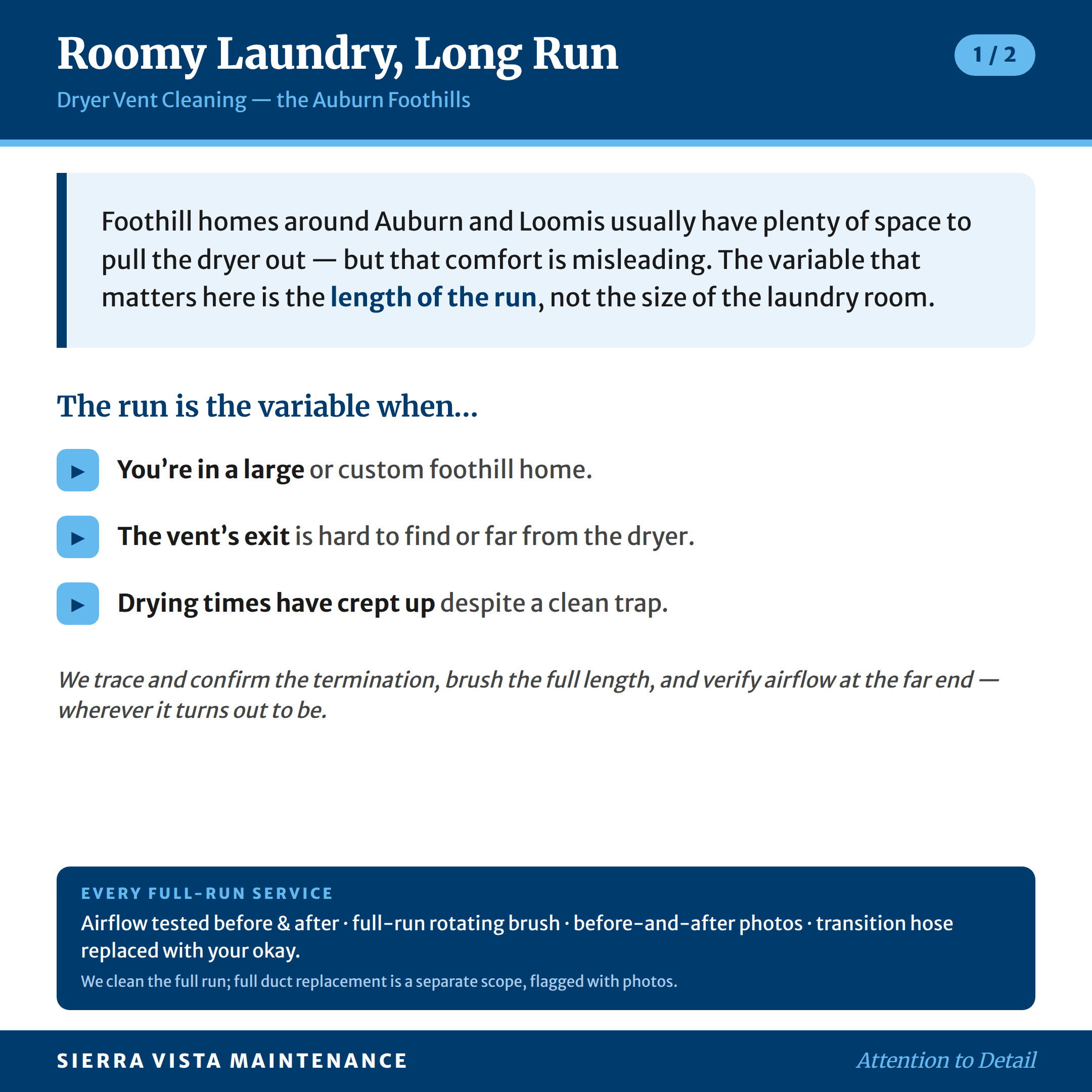
In the Auburn foothills we usually have room to work at the dryer — the challenge is the run and the exit. We confirm where the vent terminates, which can be a search of its own on a large custom home, then pull the dryer and run a rotating brush sized to your duct through the full path, which is often long on these builds.
We clear the exterior hood, check the damper, and verify airflow with an anemometer at the termination, then reconnect with a properly sized rigid or semi-rigid hose. On wooded, sloped lots we pay particular attention to the hood and any nesting or debris, because a clean termination matters more where wildfire risk is already high. Sierra Vista Maintenance serves Auburn, Newcastle, Penryn, Loomis, and Meadow Vista throughout the foothills.
What Makes Dryer Vent Cleaning in the Auburn Foothills Different
The Auburn foothills are oak and pine woodland, and much of the area is mapped as high or very-high fire hazard severity. That setting does two things to a dryer vent. The surrounding vegetation drops needles, leaves, and fine debris that collect around an exterior hood, and the elevated wildfire risk raises the stakes on the lint the vent itself produces.
A dryer vent exhausts warm, dry, intensely flammable lint. In a valley subdivision that’s a contained risk; in fire country, where defensible space and ember exposure are already daily concerns, a lint-clogged hood and an overheating dryer are exactly the kind of ignition source homeowners work to eliminate everywhere else on the property. The wooded lots also mean shaded, debris-prone terminations that hold moisture and attract nesting. Keeping the run clear and the hood clean here isn’t only about dry times — it’s part of the same fire-readiness mindset that defensible space and ember-resistant vents come from.
Common Dryer Vent Issues We See in the Auburn Foothills
- Long runs on custom homes. Large, individual builds route vents on long, sometimes hard-to-trace paths.
- Hard-to-locate exits. One local homeowner couldn’t find the exterior vent at all; on big homes we trace it.
- Woodland debris at the hood. Needles and leaves collect at terminations on wooded lots.
- Elevated fire risk. A lint-clogged vent is a real ignition concern in high fire-hazard country.
- Nesting in shaded hoods. Cool, wooded terminations attract birds and wasps.
Dryer Fire Risk in Auburn’s Foothill Fire Country
Homeowners in Auburn, Meadow Vista, and the surrounding foothills already think about fire more than most. Much of the area is mapped as high or very-high fire hazard severity, and defensible space, ember-resistant vents, and cleared brush are routine parts of owning a home here. A dryer vent belongs in that same conversation, and it’s often the one that gets missed.
A working dryer pushes warm, dry, highly flammable lint out through the vent every cycle. When the duct clogs, that lint packs up at the hood and the dryer runs hotter — and the leading cause of home dryer fires nationally is simply failure to clean (NFPA). In fire country, an overheating appliance venting into a lint-packed hood near woodland isn’t an abstract statistic; it’s the kind of ignition source the rest of your fire-prep is designed to remove. We clear the full run, clean the exterior hood, confirm the damper seals, and verify airflow at the termination — so the vent stops being the overlooked weak point in an otherwise fire-aware property. On the wooded, sloped lots common around Loomis and Newcastle, that hood check matters as much as the duct itself.

I keep up with defensible space — should I worry about my dryer vent too?
Yes. In fire country a lint-packed vent and an overheating dryer are a genuine ignition source, and failure to clean is the leading cause of home dryer fires nationally. We clear the full run and the exterior hood so the vent isn’t the weak point in an otherwise fire-aware property.
I can’t find where my dryer vent exits — can you?
Yes. On large custom foothill homes the exit isn’t always obvious; one local homeowner couldn’t locate theirs at all. We trace and confirm the termination before we clean.
My laundry room is roomy — does the size of my home matter?
It’s the run, not the room, that varies here. Custom foothill homes often have long vent runs even when the laundry space is generous, so we clean and verify end to end.
Could there be nesting or debris in my hood?
On wooded lots, yes. Shaded terminations collect needles and leaves and attract birds and wasps. We clear the hood and confirm the damper closes.
How often should it be cleaned?
Every one to two years for most homes, and more often with pets, heavy use, or a long run that loads up faster.
Request an Estimate
In most cases, we deliver same-day or next-day quotes after we speak with you on the phone or after you complete an estimate request online.