Solar Panel Cleaning in the Auburn Foothills
Local Context
The Auburn foothills climb out of the valley into Gold Country, where flat farmland gives way to oak-and-pine hills. Auburn itself is the Placer County seat, a historic Gold Rush town perched around 1,200 feet, with Loomis, Penryn, Newcastle, and Meadow Vista spread through the wooded ridges and old fruit-belt orchards around it.
This is a different climate from the valley floor: higher, cooler, and considerably wetter. The foothills catch far more rain than Sacramento — plus the occasional dusting of snow — and they’re forested, with tall pines and oaks shading many properties.
It’s also fire country. The foothills sit in a wildfire-prone belt, and smoke-and-ash season is a real part of the year here. Between the tree cover, the sap, and the ash, foothill panels contend with things valley roofs never see.
That combination — forest canopy above and fire season each summer — is what makes regular solar cleaning worth scheduling across the Auburn foothills.
How We Help Auburn Foothills Homes & Businesses
Cleaning solar in the Auburn foothills is a different job than down on the valley floor — more trees, stickier residue, and steeper roofs — and it’s terrain we know well. We clean with pure, deionized water and soft brushes. Because the minerals are filtered out, deionized water can break down sticky, resinous residue and rinse it clear without soap, drying spotless — which matters more up here, where sap and ash leave films a plain rinse can’t touch.
Most of our foothill work is residential. Our residential solar panel cleaning covers rooftop arrays across Auburn, Loomis, Newcastle, and Meadow Vista, where tree cover and fire-season ash do the most work on the glass.
We also clean commercial solar panel systems on the businesses, tasting rooms, and wineries along the Highway 49 and I-80 foothill corridors. The pure-water approach is the same; the scale and access change.
We handle the cleaning, not the electrical. Foothill roofs run steeper and more shaded, so while we’re up there we’ll flag moss taking hold, sap damage, or debris packed under the panels for your installer to address.

What Makes Solar Panel Cleaning in the Auburn Foothills Different
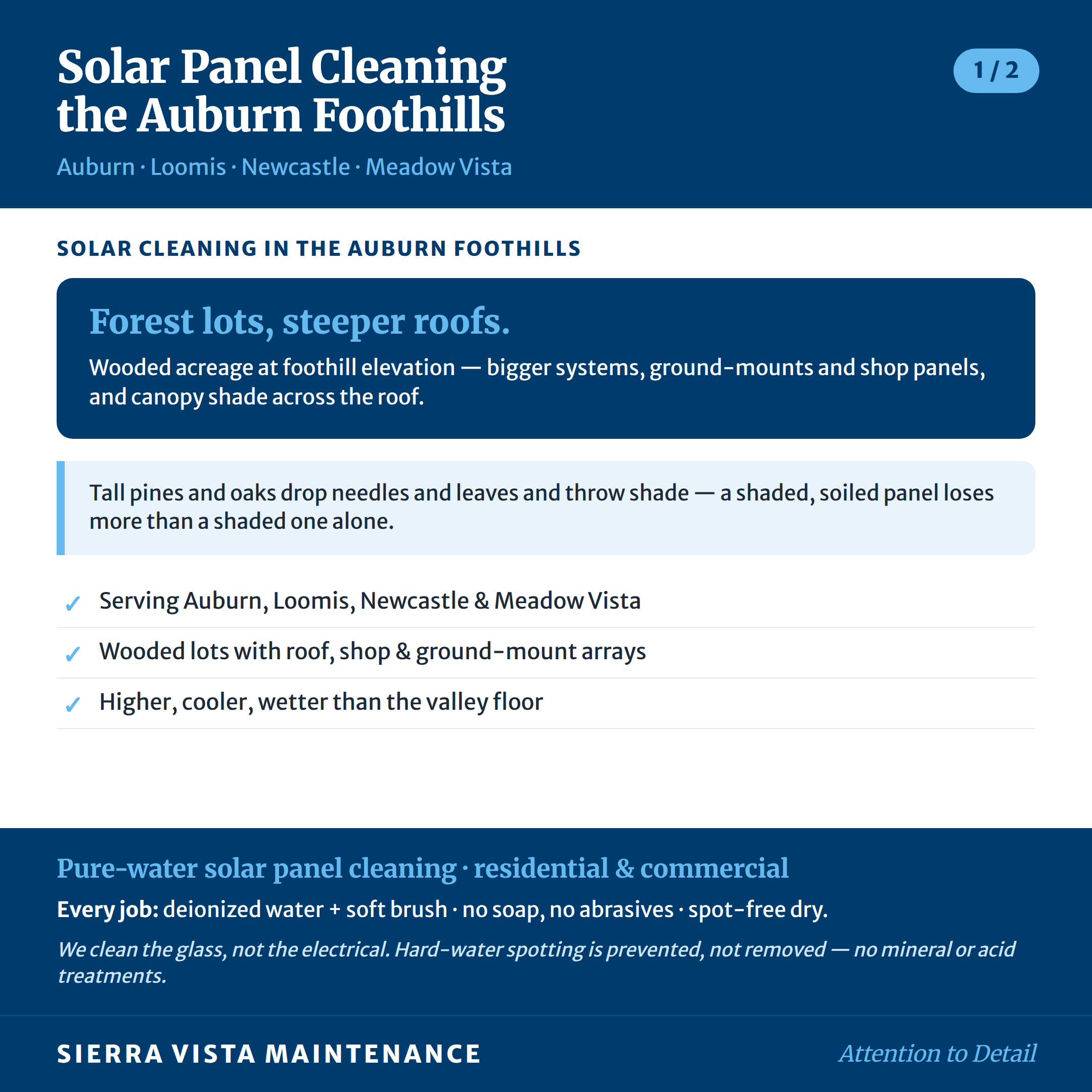
What most sets foothill panels apart is the forest around them. Auburn, Meadow Vista, and the wooded lots of Loomis and Newcastle keep tall pines and oaks that valley neighborhoods simply don’t have.
Those trees drop constantly. Pine needles, oak leaves, catkins, and the odd cone collect on the roof and in the gaps around the panels, and the canopy throws shade across arrays for part of the day. Shade is its own issue for solar: a shaded panel produces less, and a shaded-and-soiled panel less still, so under heavy tree cover keeping the glass clean matters more, not less.
Needle litter carries a second problem. It packs into the channels at the panel edges and traps moisture there, holding damp against the frame long after the roof around it has dried. That trapped moisture is exactly how moss and grime get a foothold on a foothill roof — which is why clearing the litter, not just the glass, is part of the job here.
Elevation plays in, too. The higher, cooler foothill air keeps dew on shaded morning roofs longer, giving needle-trapped moisture more time to work before the sun burns it off — one more reason the litter, not just the glass, has to come off. On the most shaded lots, we’ll often find one roof face noticeably dirtier than the rest, and that’s usually where the lost production is hiding.
Common Solar Panel Cleaning Issues We See in the Auburn Foothills
Pine sap and resin
Conifer sap drips from the branches overhead and hardens on the glass into sticky, varnish-like spots. Ordinary rain and a hose run right over them; lifting them takes pure water and a soft touch.
Wildfire-season ash
Fire season settles fine ash and oily soot on the panels. It bakes on in the summer heat and carries greasy carbon that resists a plain rinse — which is why a cleaning after the smoke clears matters up here.
Needle litter and edge moss
Pine needles pack into the gaps at the panel edges and trap moisture, feeding the moss and grime that creep in from shaded parts of the roof.
Steep, shaded roof sections
Foothill roofs run steeper and more shaded than valley ones, so panels stay damp longer and soiling clings where the sun doesn’t reach to help dry it.
Up Here, the Rain Doesn’t Rinse Sap and Ash Away
People assume the foothills’ extra rain keeps panels clean. For plain dust, it helps. For the two things that dirty foothill panels most — pine sap and wildfire ash — it barely does anything.
Sap is resin. It drips from the pines overhead and hardens on the glass into sticky, varnish-like spots that water beads off. A rain shower or a hose runs right across the top without lifting it, and left through the summer it only bakes on harder.
Wildfire ash is the other one. Fire season drops fine ash and oily soot carrying greasy carbon compounds; rain smears that into a film rather than washing it clean, and it clings to the surface instead of rinsing off.
So the foothill homeowner counting on the weather to do the cleaning is usually let down by exactly the residues that matter most. Clearing sap and baked-on ash takes pure water to break the film and a soft brush to lift it — and a cleaning timed after fire season, once the ash has settled, is the one that counts most up here.
Timing is everything with ash. A cleaning during an active smoke stretch just gets re-coated within days, so we aim for the window after the season winds down — late summer into fall — when clearing it actually holds and carries the array into the shorter, lower-sun months clean. Going into winter with clear glass matters up here, where every hour of weak foothill sun counts.
How often should I clean my solar panels in the Auburn foothills?
Twice a year fits most foothill roofs — once in spring after the pollen and needle drop, and once after fire season, which tends to be the important one here. Sap and ash don’t rinse off in the rain the way dust does, so waiting on the weather usually leaves the residues that matter most sitting on the glass.
Will hard water spots come off my panels?
Hard water spotting is best prevented, not removed. Fresh spotting from sprinkler overspray rinses off with regular service, but spots left to bake on over several summers can etch the glass and become permanent — and Sierra Vista Maintenance does not perform mineral or acid removal treatments. The fix is staying ahead of it: regular cleaning and keeping sprinkler spray off the panels keep the minerals from ever setting in.
Doesn’t all the foothill rain keep my panels clean?
It helps with plain dust, but not with the two things that dirty foothill panels most. Pine sap hardens into spots that water beads off, and wildfire ash smears into a film rather than washing away. Both need pure water and a soft brush to clear.
Do you clean commercial solar arrays in the Auburn foothills?
Yes. Along with homes, we clean the roof- and ground-mounted systems on businesses, tasting rooms, and wineries along the Highway 49 and I-80 corridors. The pure-water method is the same; we adjust for the scale, slope, and access of a foothill commercial site.
Why deionized water rather than a hose up here?
A hose can’t touch sap or baked-on ash — it runs right over the resin and smears the ash — and its tap-water minerals dry into spots of their own. Deionized water breaks those sticky films down and rinses them clear, then dries spotless with no residue left behind.
Request an Estimate
In most cases, we deliver same-day or next-day quotes after we speak with you on the phone or after you complete an estimate request online.