Dryer Vent Cleaning in the Elk Grove Area
Local Context
Elk Grove is one of the fastest-growing cities in the Sacramento region, and most of its housing is newer tract construction — Laguna, Laguna West, Laguna Ridge, and the newer Franklin and Lakeside areas went up largely in the last 20 to 25 years. These homes have long, concealed vent runs designed into two-story floor plans, often with the laundry next to or above the garage.
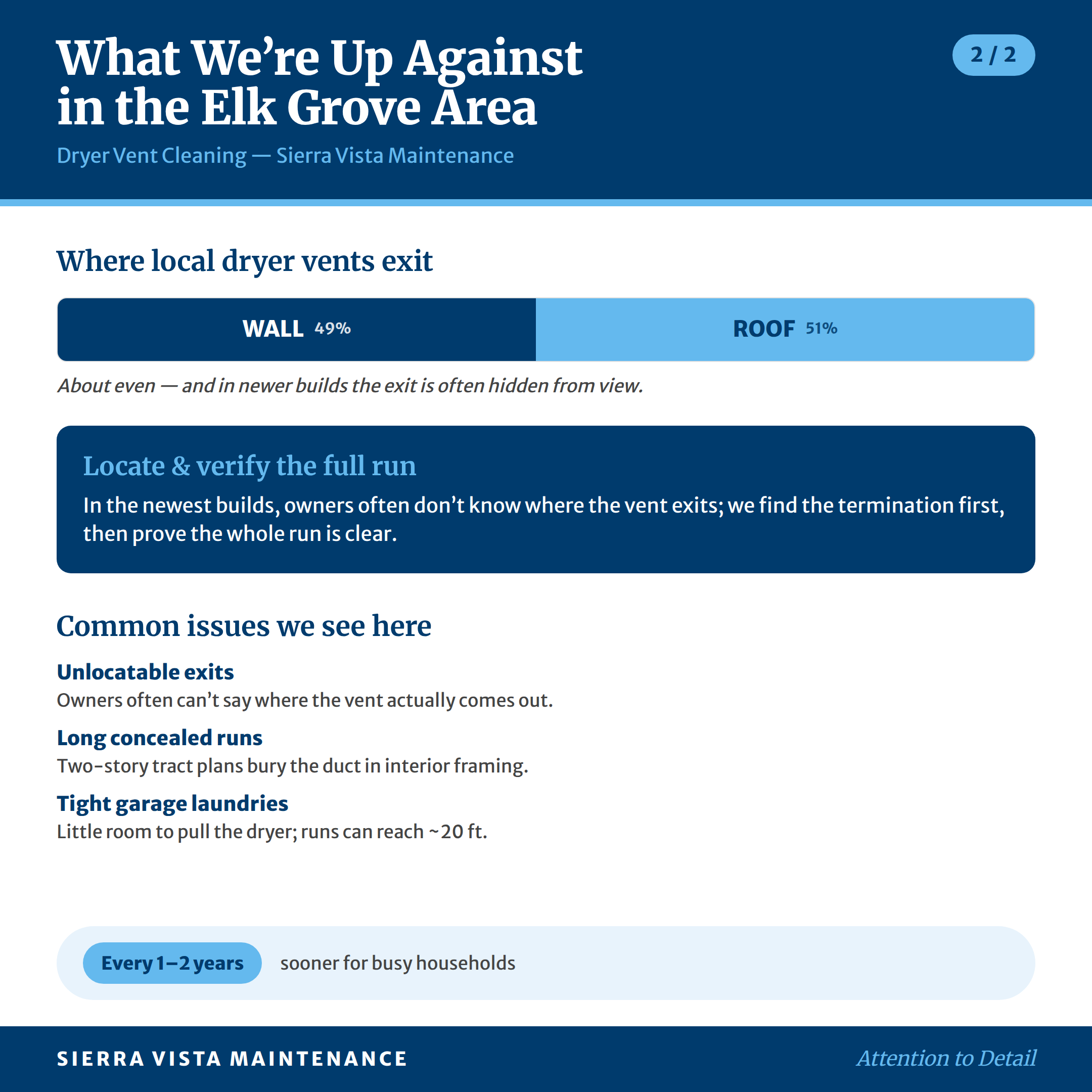
One pattern stands out in the Elk Grove estimate requests: homeowners frequently don’t know where their dryer vent actually exits the house. In the newest builds the termination is tucked under an eave, behind a fascia, or on a roof slope the owner never sees. One local request described roughly 20 feet of run to clean in a tight garage working space — typical for the area.
Rancho Murieta, grouped with Elk Grove, is different again: gated, large-lot, semi-rural properties where runs can be longer still. Across both, the common thread is a long run whose far end the homeowner can’t locate or reach.
How We Help Elk Grove Homes & Businesses
In Elk Grove’s newer homes the job starts with a question most homeowners can’t answer: where does the vent actually come out? We locate and confirm the exterior termination first — under an eave, behind a fascia, or on the roof — because you can’t verify a run is clear if you don’t know where it ends. Then we pull the dryer, disconnect the transition hose, and run a rotating brush sized to your duct through the full path, end to end.
We clear the exterior hood, check the damper, and confirm airflow with an anemometer at the termination so the whole run — not just the accessible end near the dryer — is proven clear. Then we reconnect with a properly sized rigid or semi-rigid hose. Sierra Vista Maintenance services Elk Grove and Rancho Murieta as part of the greater Sacramento region.
What Makes Dryer Vent Cleaning in Elk Grove Different
Elk Grove’s housing is some of the newest in the region, and the build era shows up in the ductwork. Two-story tract plans in Laguna, Laguna Ridge, and the newer Franklin and Lakeside areas route the dryer vent on a long, concealed path — frequently from a laundry room next to or above the garage, through interior framing, to a termination the homeowner has never laid eyes on.
That’s a different problem than an older home with a short run punched straight through a wall. The run is longer, it bends more, and the exit is hidden, so the only way to know it’s clear is to find the termination and measure airflow there. Rancho Murieta adds large-lot, semi-rural homes where runs stretch longer again. In both cases, build characteristics — not climate or debris — are what make the work distinctive here: long, concealed runs that reward tracing the full path rather than cleaning the part you can see.
Common Dryer Vent Issues We See in Elk Grove
- Unlocatable terminations. In the newest builds, owners genuinely don’t know where the vent exits — under an eave, behind a fascia, or on a roof slope they never see.
- Long concealed runs. Two-story tract plans route the duct on a long, bending path through interior framing where clogs hide far from the dryer.
- Garage-adjacent laundry, tight access. Laundry rooms next to the garage often leave little room to pull the dryer out; one local job was about 20 feet of run in a tight space.
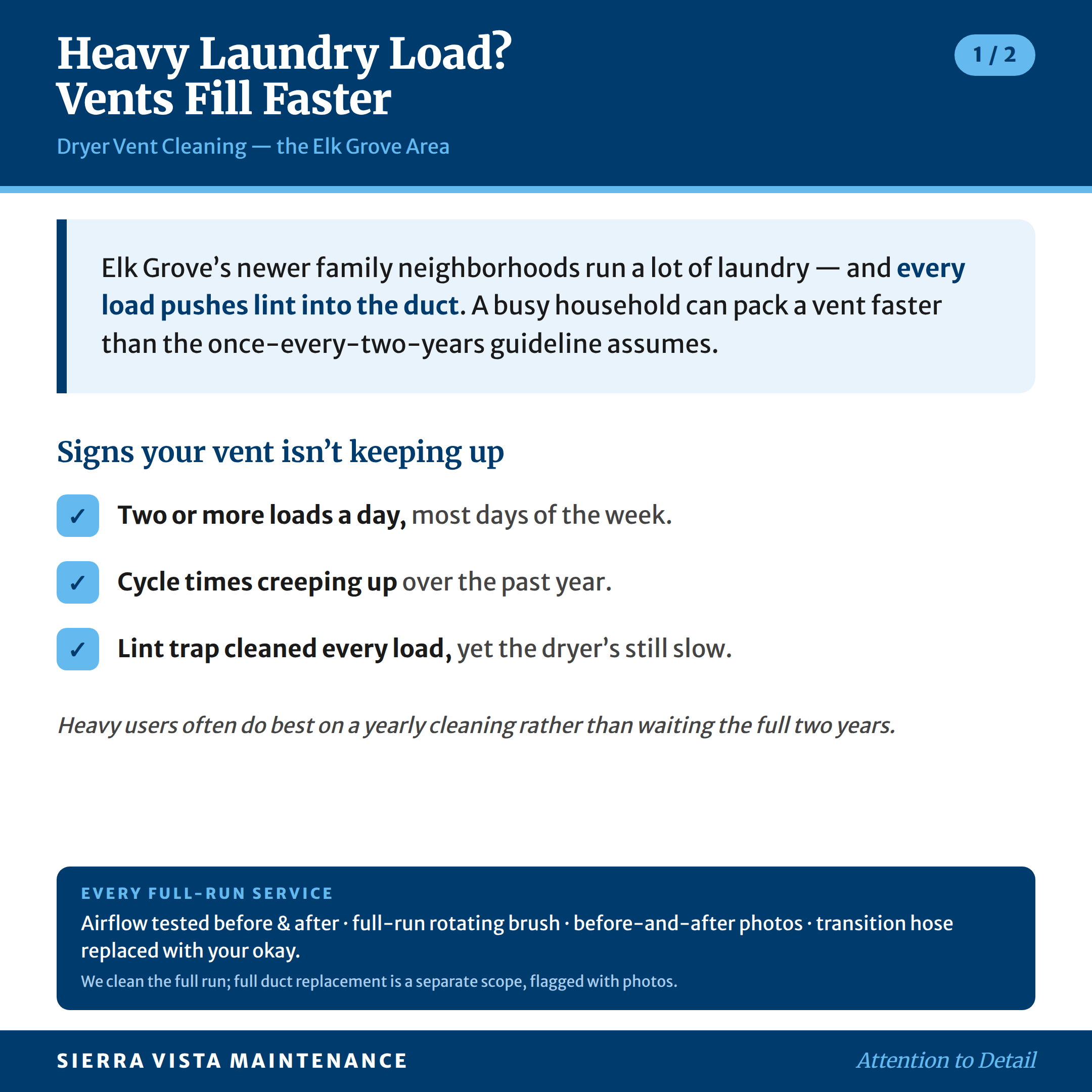
- High-throughput young families. Elk Grove’s newer family neighborhoods run heavy laundry loads that pack the duct faster.
- Longer rural runs in Rancho Murieta. Large-lot homes can have longer runs and harder-to-reach terminations.
Finding and Verifying the Full Vent Run in Newer Elk Grove Builds
“I’m not sure exactly where the dryer vents to the exterior” is one of the most common things Elk Grove homeowners tell us — and it’s not carelessness. In the newer two-story tract homes that fill Laguna, Laguna Ridge, Franklin, and Lakeside, the termination is often tucked under an eave, hidden behind a fascia, or set on a roof slope nobody walks past. The run that gets there is long and concealed, threading through interior framing from a laundry room next to or above the garage.
That’s why we treat locating the exit as step one, not an afterthought. We trace the run and confirm the exterior termination before we start, then brush the duct end to end and walk the debris back to where we can vacuum it. The reason it matters: if you don’t know where the run ends, you can’t prove it’s actually clear — you can only clear the part you can reach. We close every Elk Grove job with an anemometer reading at the termination, so the whole run has a measured airflow number behind it, not a guess. For larger Rancho Murieta properties with longer runs, that verification matters even more.

I don’t know where my dryer vent exits — is that a problem?
Not for us — it’s one of the most common things Elk Grove homeowners say. In newer builds the termination is often hidden under an eave, behind a fascia, or on a roof slope. We locate and confirm the exit first, because that’s the only way to prove the full run is clear rather than just the part near the dryer.
My laundry is next to the garage with a long run — can you clean the whole thing?
Yes. Long, concealed runs are standard in Elk Grove’s two-story tract homes. We run a rotating brush sized to your duct end to end — one local job was around 20 feet of run — and verify airflow at the termination so the entire path is clear.
The space behind my dryer is tight — will that be an issue?
No. Garage-adjacent laundry rooms often leave little room, and we’re used to it. We ease the dryer out, clean from the best available access, and reconnect with a properly sized hose so nothing gets crushed when the dryer goes back.
We do a lot of laundry — how often should we clean the vent?
Every one to two years for most homes, and more often for busy households running several loads a day, which is common in Elk Grove’s newer family neighborhoods. Heavy use packs the duct faster.
I’m in Rancho Murieta on a larger lot — does that change the job?
Sometimes. Large-lot and semi-rural homes can have longer runs and terminations that are harder to reach, so verifying airflow at the exit matters even more. The full-run approach is the same; there’s just more run to trace and confirm.
Request an Estimate
In most cases, we deliver same-day or next-day quotes after we speak with you on the phone or after you complete an estimate request online.