
Window Cleaning in the Fair Oaks Area
Local Context
The Fair Oaks Area sits north of the American River, anchored by four established suburbs — Fair Oaks, Citrus Heights, Orangevale, and Antelope — that filled in between the 1950s and the 1980s. Most of the housing here is single-story ranch and split-level, built when lots were larger and tree planting was generous. The result is a region with a lot of glass facing a lot of trees: picture windows, sliding patio doors, and the original aluminum-framed windows that came with mid-century construction.
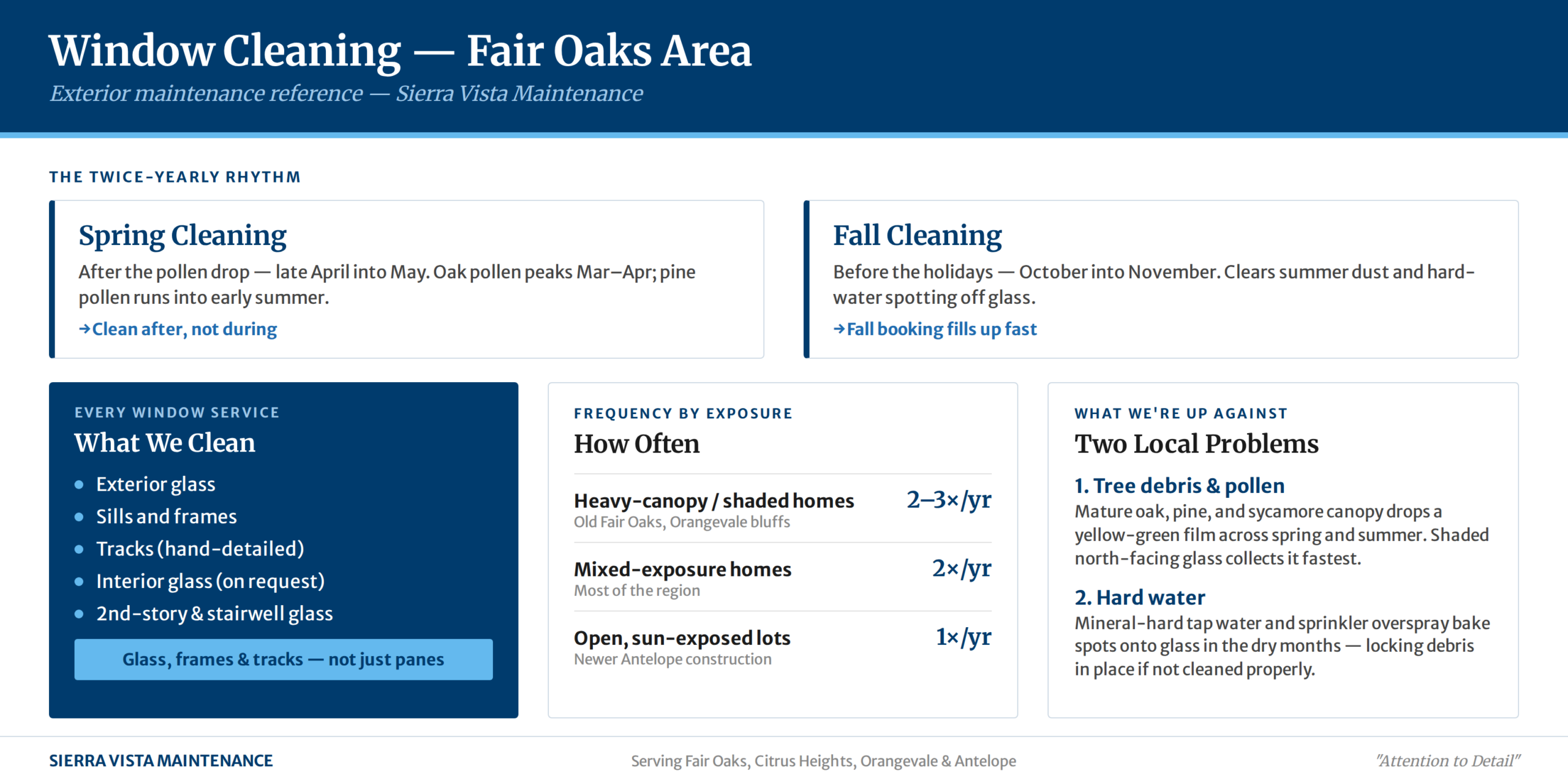
That combination matters for window cleaning. Oak pollen peaks in March and April, and pine pollen runs through early summer, leaving a yellow-green film on glass that the area’s mineral-hard tap water bonds into a stubborn haze if it isn’t cleaned off properly. Homes in older Fair Oaks and the Orangevale bluffs sit under heavy canopy, so their windows collect more organic debris and shaded-side grime than newer, more open lots in Antelope.
Sacramento County averages around 18–20 inches of rain a year (per NOAA), almost all between November and March. Winter storms drive dust and tannin streaks down the glass; the long dry summer bakes sprinkler overspray and hard-water spots onto exterior panes. Two distinct cleaning seasons fall out of that pattern naturally — a post-pollen spring cleaning and a pre-holiday fall cleaning — which is how most Fair Oaks Area homes end up on a twice-a-year rhythm.
How We Help Fair Oaks Area Homes & Businesses
Window cleaning in the Fair Oaks Area is mostly a battle with two things: tree debris and hard water. The region’s mature oak, pine, and sycamore canopy drops pollen and organic film across spring and summer, and the local tap water is mineral-hard enough to leave spots that bond to glass in the dry months. Sierra Vista Maintenance cleans the full window — glass, frames, and tracks — so you’re not left with sparkling panes sitting in gritty aluminum channels.
A standard residential cleaning covers exterior glass, sills, and tracks, with interiors available on request. We hand-detail the frames and tracks on older homes, where original aluminum windows hold decades of accumulated grit that quick-pass services skip. For two-story homes and the split-levels common across Fair Oaks and Orangevale, we bring the right reach equipment for high stairwell and entryway glass instead of leaving those panes for you to deal with.
We work residential and commercial in the region — single-family homes, but also small office frontage and HOA common-area glass along the corridors. Most Fair Oaks Area homes land on a twice-yearly schedule: a spring cleaning after the pollen drop and a fall cleaning before the holidays. We’ll tell you honestly whether your glass needs that cadence or whether annual service is enough for your exposure. Same-day and next-day quoting keeps the booking simple once you decide.
What Makes Window Cleaning in the Fair Oaks Area Different
Drive any street in Old Fair Oaks Village or the older parts of Orangevale and you’ll see the issue before we explain it: rooflines and windows sitting under oaks, pines, and sycamores that were planted generously when these neighborhoods went in sixty-plus years ago. That canopy is the single biggest factor in how often your windows actually need cleaning here.
Tree cover changes window cleaning in three concrete ways. First, timing — oak pollen peaks in March and April and pine pollen runs into early summer, so a spring cleaning done too early just gets re-coated. We schedule Fair Oaks Area spring cleanings after the pollen drop, not during it. Second, exposure — north-facing and shaded windows under heavy canopy grow organic film and light algae far faster than open, sun-exposed glass, so the shaded side of your house often needs more attention than the front. Third, the water problem compounds the debris problem: pollen and dust settle on glass, then the area’s hard tap water (from sprinkler overspray or a quick rinse) dries into a mineral haze that locks the grime in place.
Newer, more open lots in Antelope deal with less of this. But across the mature core of the region — Fair Oaks, older Citrus Heights, the Orangevale bluffs — the canopy is why annual cleaning usually isn’t enough, and why we default to recommending a twice-yearly rhythm tuned to the pollen calendar rather than a generic schedule.
Common Window Issues We See in the Fair Oaks Area
Most window cleaning calls in this region cluster around a handful of recurring problems — patterns predictable enough that our crews know to look for them by neighborhood and housing era.
- Original aluminum tracks and frames full of grit. A meaningful share of mid-century Fair Oaks and Citrus Heights homes still have their original aluminum windows. The tracks hold decades of accumulated dirt that a quick squeegee pass never touches. Working the tracks and frames is part of our standard service here.
- Hard-water spotting from sprinkler overspray. Lawn sprinklers along the side of the house throw mineral-hard water onto ground-floor glass. Left through enough dry-season cycles, it bonds into a haze that ordinary cleaning won’t lift.
- Organic film on shaded north-facing glass. Under the region’s heavy oak and sycamore canopy, shaded windows grow a green-gray biological film far faster than sun-exposed glass. It comes back each season once established.
- Pollen haze in spring. Oak and pine pollen coats glass through March into early summer, dulling windows that were cleaned too early in the season.
- High stairwell and entryway glass left undone. On split-levels and two-story homes, the hardest-to-reach panes are the ones most often skipped by homeowners and quick-pass services alike.
These aren’t problems we manufacture to upsell — they’re things our crews are trained to spot and document. Whether you address them with us or another contractor is your call.
North-Facing and Shaded-Side Glass Under the Fair Oaks Canopy
The windows that age worst in this region are almost always the ones that never see direct sun. Under the heavy oak and sycamore canopy across Fair Oaks and the Orangevale bluffs, north-facing glass and shaded side-yard windows stay damp longer after every rain and every morning of fog. That lingering moisture, combined with the organic debris the canopy constantly sheds, grows a thin film of algae and mildew that clear, sun-baked glass on the same house never develops.
You can usually spot it from inside: the front windows look fine, but the panes along the shaded side of the house have a dull green-gray cast that doesn’t wipe off with a household cleaner. That’s because it isn’t surface dust — it’s biological film keyed into the glass and the frame corners, and it comes back faster each season once it’s established. A standard quick-pass cleaning skips it because it takes more than a squeegee to remove.
We treat the shaded side of a Fair Oaks Area home as its own job, not an afterthought. That means working the frame corners and track channels where film collects, not just the open glass, and flagging the windows that are trending toward needing a third yearly cleaning so you can decide before the buildup gets stubborn. It’s the main reason we tell homeowners here to look at exposure, not just calendar months, when they decide how often to book.
How often should I have my windows cleaned in the Fair Oaks Area?
Twice a year works for most homes here — once in late spring after the oak and pine pollen settles, and once in fall before the holidays. Homes under heavy canopy in older Fair Oaks or near the Orangevale bluffs often add a third cleaning, because shaded north-facing glass collects organic film faster.
Will hard water spots come off my windows, or are they permanent?
Water spots baking in the sun over many years become hard water spots. Unfortunately, those spots do not come out without specialized mineral-removal treatments. We do not offer hard water removal at this time.
However, not all water spots are hard water spots. Non-hard water spots come off easily during a regular window cleaning service.
Do you clean the original aluminum-framed windows on older homes?
Yes. A lot of mid-century homes in Fair Oaks and Citrus Heights still have their original aluminum frames and tracks, full of decades of grit. Working the tracks and frames is part of our standard window service, not an add-on.
Can you reach second-story and stairwell windows?
Yes. Split-levels and two-story homes in the region often have high stairwell glass and windows over entryways. We bring the equipment to reach them safely rather than skipping the panes that are hardest to get to.
Do you do interior glass too, or just exterior?
Both, if you want it. Plenty of homeowners book exterior-only for routine maintenance and add interiors before holidays or after a remodel. You choose per visit.
Request an Estimate
In most cases, we deliver same-day or next-day quotes after we speak with you on the phone or after you complete an estimate request online.