Dryer Vent Cleaning in Folsom & El Dorado Hills
Local Context
Folsom and El Dorado Hills sit along the Highway 50 corridor in the lower Sierra foothills, east of Sacramento. Neighborhoods like Empire Ranch and Broadstone in Folsom and Serrano, Blackstone, and Promontory in El Dorado Hills are large-lot, two-story homes, many built since the late 1990s, frequently with concrete or clay tile roofs and rooftop solar.
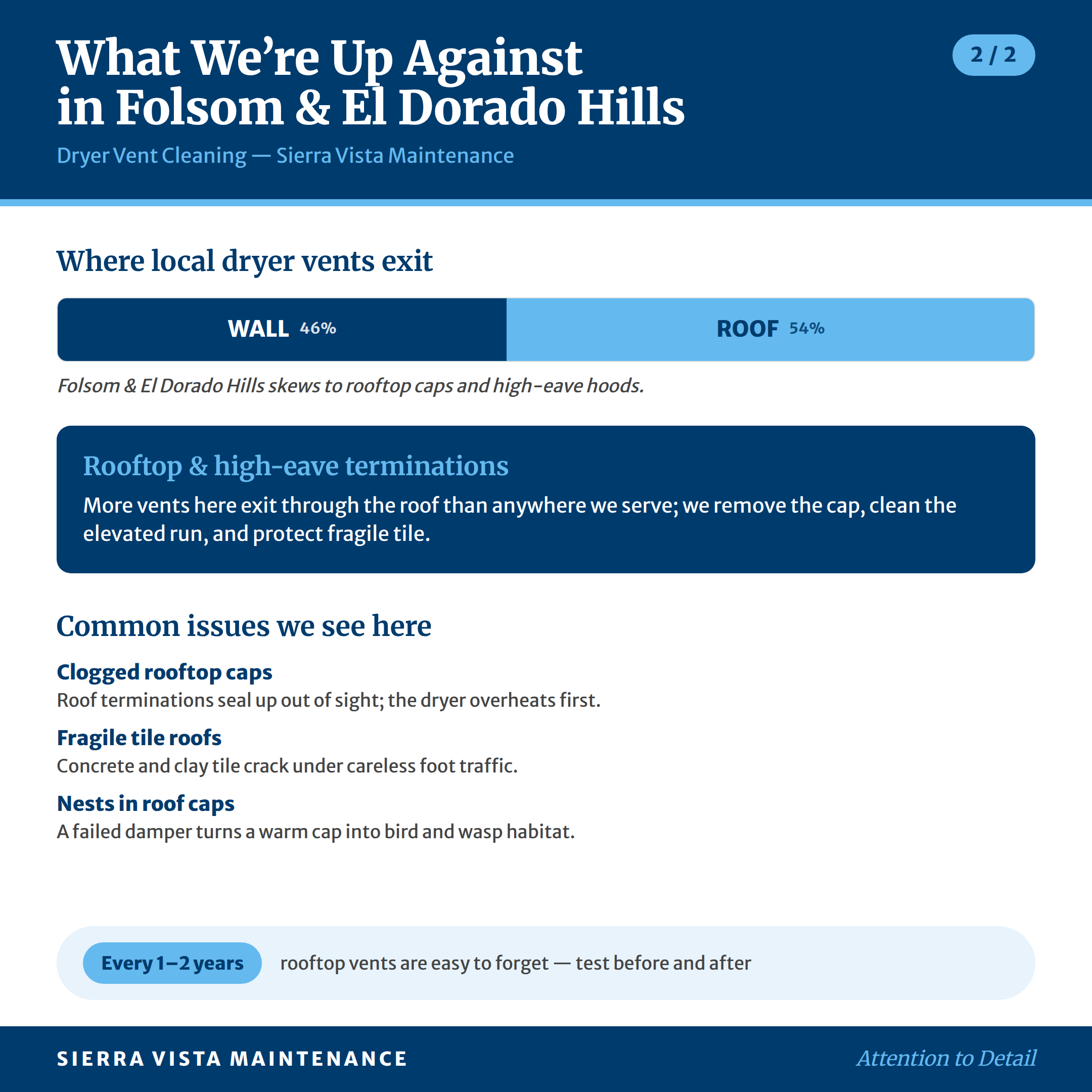
Those features shape dryer vent work here more than anywhere else in the region. The estimate requests we get from Folsom and El Dorado Hills skew toward rooftop terminations — the vent exits through the roof rather than a side wall — and toward second-floor laundry rooms that vent high up under the eave.
That puts the cap on a tile roof or the termination two stories up, where a homeowner with a shop-vac has no realistic way to reach it. Cameron Park, just up the corridor, follows the same pattern, as do the region’s smaller communities like White Rock and Franciscan Village. The result is a vent that gets ignored for years simply because it’s out of reach.
How We Help Folsom & El Dorado Hills Homes & Businesses
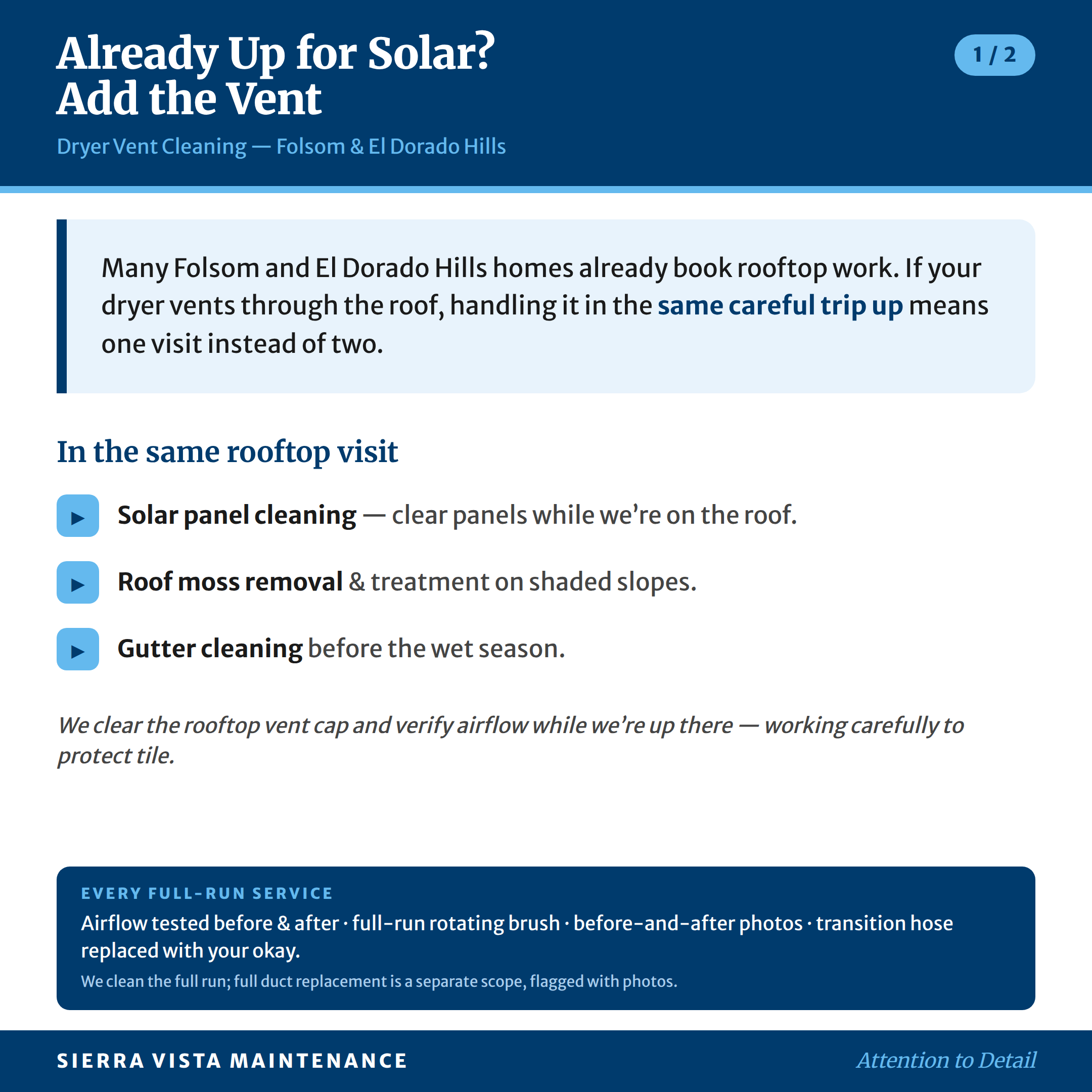
A full service starts inside — we pull the dryer, disconnect the transition hose, and inspect behind it — then follows the run to wherever it ends. For the rooftop and high-eave terminations common in Folsom and El Dorado Hills, we open and clear the cap, run a rotating brush sized to your duct through the full path, and check the cap for the bird and wasp nesting we regularly find in foothill roof vents.
On fragile concrete and clay tile roofs we work carefully and, where the run allows, clean from inside to avoid stepping on tile. We verify airflow with an anemometer at the termination so there’s a measured number confirming the whole run is clear, then reconnect the dryer with a properly sized rigid or semi-rigid hose. Sierra Vista Maintenance has serviced these foothill homes since 2010.
What Makes Dryer Vent Cleaning in Folsom & El Dorado Hills Different
The housing stock here is newer, larger, and built up rather than out. Two-story floor plans put the laundry on the second floor, and the vent climbs to a roof cap or a termination tucked high under the eave instead of exiting at ground level. Many of these homes wear concrete or clay tile roofs and carry rooftop solar — both of which make the termination harder and riskier to reach.
That combination is why a Folsom or El Dorado Hills dryer vent so often goes years without service: there is no safe DIY way to get to it. It also raises the stakes on doing the cleaning right, because a clog at a rooftop cap can’t be spotted from the laundry room. We size the rotating brush to your duct, clear the cap, and confirm the result with a meter reading at the exit — the only way to know a long, elevated run is actually clear rather than just clear at the bottom.
Common Dryer Vent Issues We See in Folsom & El Dorado Hills
- Clogged rooftop caps. Roof terminations collect lint and seal up where no one can see them; the dryer overheats long before the homeowner spots the cause.
- Fragile tile-roof access. Concrete and clay tile cracks under careless foot traffic; we work carefully and clean from inside where the run allows.
- High-eave second-floor terminations. Vents exiting two stories up under the eave are out of reach for any homeowner tool.
- Bird and wasp nests in roof vents. A failed damper flap turns a warm roof cap into prime nesting habitat — one local request flagged a roof vent clogged with a dormant wasp nest.
- Tight interior laundries in newer builds. Many 2018-era homes pair the long run with a cramped side-by-side laundry that’s hard to pull the dryer out of.
Rooftop and High-Eave Vent Terminations on Folsom and El Dorado Hills Homes
More dryer vents exit through the roof in Folsom and El Dorado Hills than in any other area we serve. With the laundry on the second floor of a two-story home, the shortest path out is up — to a roof cap or a hood mounted high under the eave. One local homeowner described their vent exiting the exterior wall “way up high” just under the eave; another’s ran 25 feet up to a roof termination. These are not jobs a shop-vac can touch.
Cleaning them right means getting to the cap and verifying the run from the top down. We remove the exterior cap, run a rotating brush sized to the duct through the full elevated path, and clear any nesting we find at the termination. On the concrete and clay tile roofs that are common here, we move carefully and clean from inside the run wherever the layout allows, so we’re not putting weight on tile that costs hundreds of dollars a piece to replace. Then we confirm airflow with an anemometer at the exit — because on a long rooftop run, a measured reading at the cap is the only honest proof the whole vent is clear.

My dryer vent exits through the roof — can you still clean it?
Yes. Roof terminations are common in Folsom and El Dorado Hills. We remove the exterior cap, run a rotating brush through the full run, clear any nesting at the cap, and verify airflow with a meter at the roof so we know the whole vent is clear.
I have a tile roof — will cleaning the vent risk cracking tiles?
We work carefully on tile and, where the run allows, clean from inside the duct so we avoid putting weight on the roof at all. Where roof access is unavoidable we use techniques that protect the tile. We’d rather take longer than leave you with broken tile.
My laundry is on the second floor — why does that matter?
Second-floor laundry rooms vent through long runs with more elbows before reaching a roof cap or high eave. Long runs trap more lint per foot and hide clogs farther from the dryer, so we verify exit airflow at the termination rather than assuming the first accessible stretch tells the whole story.
Could something be nesting in my roof vent?
It happens here more than most homeowners expect. When the damper flap fails, a warm roof cap becomes ideal nesting habitat for birds and wasps, which both block airflow and add dry, combustible material right at the heat-and-lint exit. We check and clear the cap as part of every service.
How often should a foothill home get this done?
Every one to two years for most homes, and more often with pets or heavy use. Because foothill roof vents are out of sight, they’re easy to forget — the airflow test we run before and after gives you a clear baseline.
Request an Estimate
In most cases, we deliver same-day or next-day quotes after we speak with you on the phone or after you complete an estimate request online.