Roof Cleaning in Folsom & El Dorado Hills
Local Context
Folsom and El Dorado Hills sit where the Sacramento Valley floor climbs into the Sierra foothills, and the roofs here reflect that split. The master-planned neighborhoods that filled in between the mid-1990s and the mid-2010s — Empire Ranch, Blackstone, Serrano, and the developments strung along the Highway 50 grade — went up largely under concrete and clay tile. Older Folsom, closer to the historic district and the river, carries more composition shingle, and the foothill lots around Cameron Park and White Rock add mature oak and pine right over the roofline.
That mix matters, because what’s on top of a house decides both how it gets cleaned and how long the results take to show. Tile and shingle don’t respond to the same method, and a crew that treats them the same way either leaves the tile half-done or takes years of life off the shingle.
The other constant here is shade. Homes on open, full-sun lots collect mostly dust and a season’s fire-season ash. Homes tucked under oak canopy — common across the older Folsom streets and the wooded El Dorado Hills parcels — grow moss on the north slope that never fully dries between November and April. Two houses on the same street can end up on completely different cleaning schedules based on nothing but tree cover.
This is also the region where roof cleaning and solar panel cleaning overlap the most. El Dorado Hills in particular pairs the two more than any other community Sierra Vista Maintenance serves, which introduces a sequencing question most roofs don’t face.
How We Help Folsom & El Dorado Hills Homes & Businesses
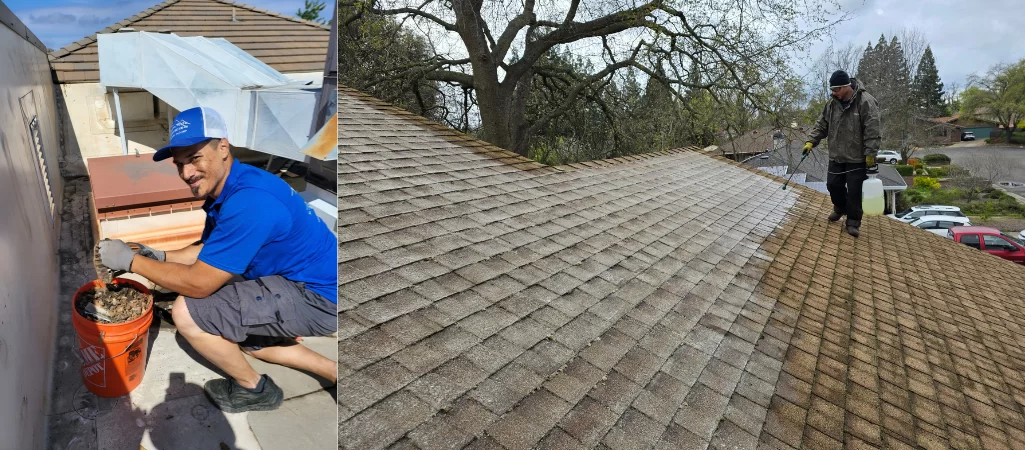
Sierra Vista Maintenance cleans roofs — composition shingle, concrete and clay tile, metal, and low-slope commercial. We do not repair, seal, or replace them. Moss is most of the work, and the method depends on what’s on top of your house: on shingle we brush off the heavy clumps and soft-wash the slope with a low-pressure sodium hypochlorite and surfactant solution, which kills the moss at the root and lets it wash off over the next few rains — we never pressure wash a shingle roof, because that strips the granules protecting it. On tile we pull the moss and debris off mechanically, then rinse at low pressure, and the roof reads finished the same day. We don’t clean wood shake at all, and if we find cracked tile, lifted flashing, or a roof at the end of its life, we photograph it and tell you on the estimate so you can bring in a roofer — we’re cleaners, not roofers.
In Folsom and El Dorado Hills that usually starts with clearing the valleys, eaves, and the flashing behind chimneys, where oak and pine debris collects and holds water against the roof. From there the work follows the material and the exposure: a shaded north slope gets the moss treatment, an open south face often needs little more than a debris clear and a rinse. Every job ends with ground cleanup and before-and-after photos sent to your email, so you can see what the roof looked like before and after without ever climbing a ladder yourself.
Because so many homes here run solar, we schedule roof and panel cleaning together when a customer wants both — roof first, panels last — so you get one visit in the right order instead of two trips or a re-clean.


What Makes Roof Cleaning in Folsom & El Dorado Hills Different
The defining feature of a Folsom or El Dorado Hills roof is what hangs over it. The region’s mature valley oak, cork oak, and foothill pine don’t have a single drop season — they shed catkins and pollen in spring, twigs and bark through the summer heat, and a heavy leaf-and-needle load in the fall. That debris lands on the roof first, collects in the valleys and behind the chimney, and holds moisture against the surface long enough to start growing moss right where it sits.
The shade those same trees throw is the other half of the problem. A north-facing slope under oak canopy can go the entire wet season without drying out, and moss anchors between the shingle tabs or under the tile edges and stays. On the wooded El Dorado Hills parcels and the older tree-lined Folsom streets, that shaded slope is usually the only part of the roof that needs treating — but it needs it reliably, twice a year on the heaviest-canopy lots.
Pine adds its own wrinkle in the foothill pockets around Cameron Park and White Rock. Needles knit together into a mat that sheds water poorly and sits in the valleys, and during fire season that same dry mat is an ember catch. Clearing it is both a roof-maintenance step and a defensible-space one. This is why we treat exposure, not address, as the thing that sets a cleaning schedule here — the tree cover over your particular roof matters more than which neighborhood it’s in.
Common Roof Cleaning Issues We See in Folsom & El Dorado Hills
A handful of problems come up again and again on roofs across this region, and most of them trace back to shade, tree litter, or the mix of roof materials here.
Moss on the north slope. The shaded face under oak canopy holds moisture all winter and grows moss between the shingle tabs or under the tile edges. Left alone over several seasons it lifts the material and shortens the roof’s life. This is the single most common reason people call.
Debris packed in the valleys and behind chimneys. Oak and pine drop year-round here, and the valleys and flashing are where it collects, holds water, and feeds moss. It’s also what ends up in the gutters below, which is why roof and gutter work so often go together.
Fire-season ash that bonds after the first rain. Ash settles across the region every fall. Dry, it blows off; once the first rain hits it, it bonds to shingle and tile and takes a wash rather than a rinse to lift.
Moss along the solar racking line. On homes with panels, the shaded strip under and around the array stays damp and grows moss first, often unnoticed from the ground.
Roofs and Solar Arrays
El Dorado Hills pairs roof cleaning and solar panel cleaning more often than any other community Sierra Vista Maintenance serves, and that combination changes how a visit is run. The instinct is to clean the panels — they’re the reason for the call, and they’re what the homeowner can see from the ground. But cleaning the array first is a mistake, because everything above it is about to come down onto it.
When we handle both, we work the roof first. Debris comes out of the valleys, the moss gets brushed and treated, and the slope gets its soft-wash. Then the roof rinses, and the loosened moss and runoff run downhill and off the eaves. Only then do we clean the panels — last, so they stay clean. Reverse that order and you’re cleaning the array twice: once for itself, and again for everything the roof sent down onto it an hour later.
The panels also create their own moss problem, which is easy to miss from the driveway. An array shades the deck directly under and around it, and that strip of roof stays damp long after the open slopes have dried in the morning sun. Moss tends to anchor along the racking line first, in the shadow the panels throw. So even on an otherwise clean-looking roof, the edges of the array are worth checking every visit. Scheduling the two services together isn’t just convenient here — it’s the order that actually keeps both clean.
My roof has solar panels. Can you still clean it?
Yes, and when both are on the same visit the order matters. We clean the roof first, let it rinse, then finish the panels — because soft-wash solution and loosened moss run downhill, and cleaning an array before the roof above it means cleaning it twice.
How long until the moss is gone?
It depends on your roof. On concrete or clay tile we pull the moss and debris off mechanically and rinse, so the roof reads finished the same day. On composition shingle we brush off the heavy clumps and soft-wash the slope; the moss dies at the root and washes off over the next few rains, so a shingle roof keeps clearing for a few weeks after we leave.
Why is the moss only on one side of my roof?
The north-facing slope stays shaded longest and holds moisture longest, especially under the oak canopy common in Folsom and the wooded parts of El Dorado Hills. That’s the face that grows moss, and often it’s the only side that needs treating — we don’t clean a slope that’s fine just to pad the job.
Do you pressure wash the roof?
Not on shingle. High pressure strips the granules that protect a composition roof and voids most shingle warranties. We soft-wash instead. On concrete tile we use gentle pressure after clearing the debris by hand. We never power wash a commercial membrane roof either, since the wrong pressure voids most membrane warranties.
What if you find damage up there?
We photograph it and tell you on the estimate. Sierra Vista Maintenance cleans roofs — we don’t repair, seal, or replace them — but if we spot cracked tile, lifted flashing, or a roof near the end of its life, you’ll see it in the photos and we’ll help point you toward a roofer.
Request an Estimate
Whether it’s a tile roof in Serrano or a shaded shingle slope in old Folsom, we’ll match the method to your roof and show you the before-and-after. In most cases, we deliver same-day or next-day quotes after we speak with you on the phone or after you complete an estimate request online.