Solar Panel Cleaning in Folsom & El Dorado Hills
Local Context
Folsom and El Dorado Hills sit at the eastern edge of the Sacramento metro, where Highway 50 climbs out of the valley toward the Sierra foothills. Folsom hugs the American River and Folsom Lake; El Dorado Hills rises into rolling oak-woodland hills just across the county line.
This is a newer, larger-lot part of the region. Much of the housing in Folsom, El Dorado Hills, and Cameron Park went up from the 1990s onward during the Highway 50 growth boom, which means big roofs, generous lots, and a lot of solar — this is one of the most solar-heavy areas we serve. Homes here tend to sit on open, sun-exposed roofs rather than tucked under old shade trees.
The catch is the summer. Sitting away from the Sacramento–San Joaquin Delta, this area misses most of the afternoon Delta breeze that cools the valley floor, so rooftops run hot and dry from June well into September with almost no rain to rinse them. A season of pollen, dust, and fire-season haze builds up on the glass and stays there.
Whether you own a home in the hills or run a business along the Highway 50 corridor, that mix of big sun-exposed arrays and long, hot, rainless summers is what makes regular solar panel cleaning worth scheduling here.
How We Help Folsom & El Dorado Hills Homes & Businesses
We clean rooftop solar arrays using pure, deionized water and soft-bristle tools on extension poles. Deionized water has had its minerals stripped out, so it lifts pollen, dust, and grime off the glass and then dries with no spots or streaks — no soap, and no residue left behind to attract the next layer of dust.
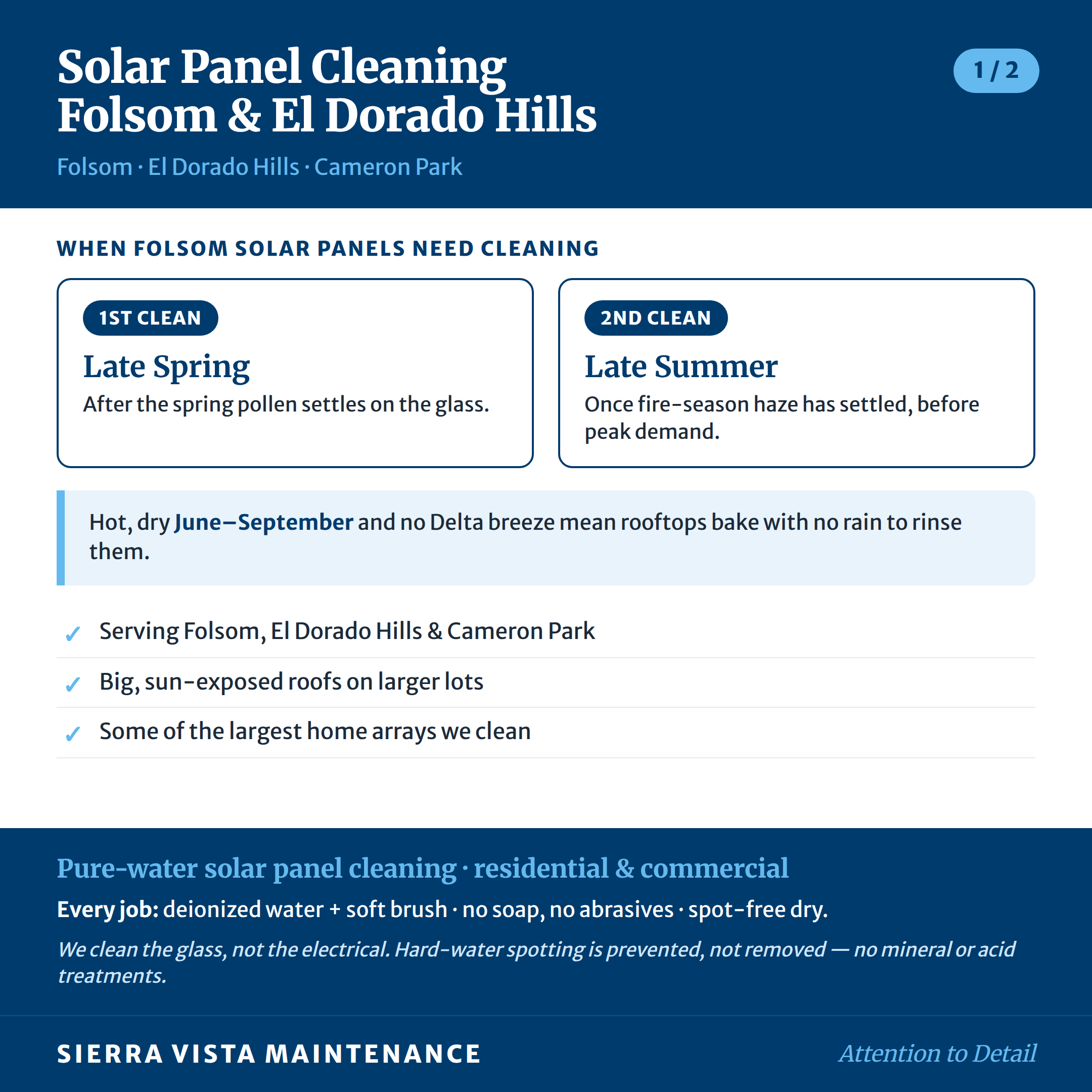
Most of our work here is residential. Our residential solar panel cleaning covers the rooftop arrays on homes across Folsom, El Dorado Hills, and Cameron Park, where big south-facing roofs collect a full summer of soiling. We time most cleanings for late spring, after the pollen drops, and again in late summer once fire-season haze has settled, so your panels are clear through the highest-production stretch of the year.
We also clean commercial solar panel installations — the larger roof- and ground-mounted arrays on businesses, office parks, and HOA facilities along the Highway 50 corridor. The pure-water method is the same; the scale and roof access are what change.
We clean the glass; we don’t service the electrical side of your system. If we spot a cracked panel, a loose clamp, or wiring that looks off while we’re up there, we’ll tell you so you can get the right person out to look at it.

What Makes Solar Panel Cleaning in Folsom & El Dorado Hills Different
The thing that sets this area apart is heat with no relief. Folsom, El Dorado Hills, and Cameron Park sit far enough from the Delta to lose most of the afternoon breeze that cools Elk Grove and the valley floor, so on a 100-degree day dark rooftop panels can climb far hotter than the air around them.
Heat does two things to a dirty panel. It bakes loose dust and pollen into a hard film that a rinse won’t lift, and it turns any isolated spot — a dropping, a dust clump — into a hot spot the system has to work around. On top of that, this is the eastern edge of the valley, where drifting wildfire ash and resinous soot tend to settle during fire season. That soot carries oily carbon compounds that ordinary rain won’t fully rinse away once it bakes on.
Because summers here run long, hot, and essentially rainless from June through September, nothing clears the panels on its own between spring and the winter rains. That’s the window where soiling quietly costs you production, and it’s why we treat a late-summer cleaning as the important one in this part of the region.
Common Solar Panel Cleaning Issues We See in Folsom & El Dorado Hills
Baked-on pollen and summer dust
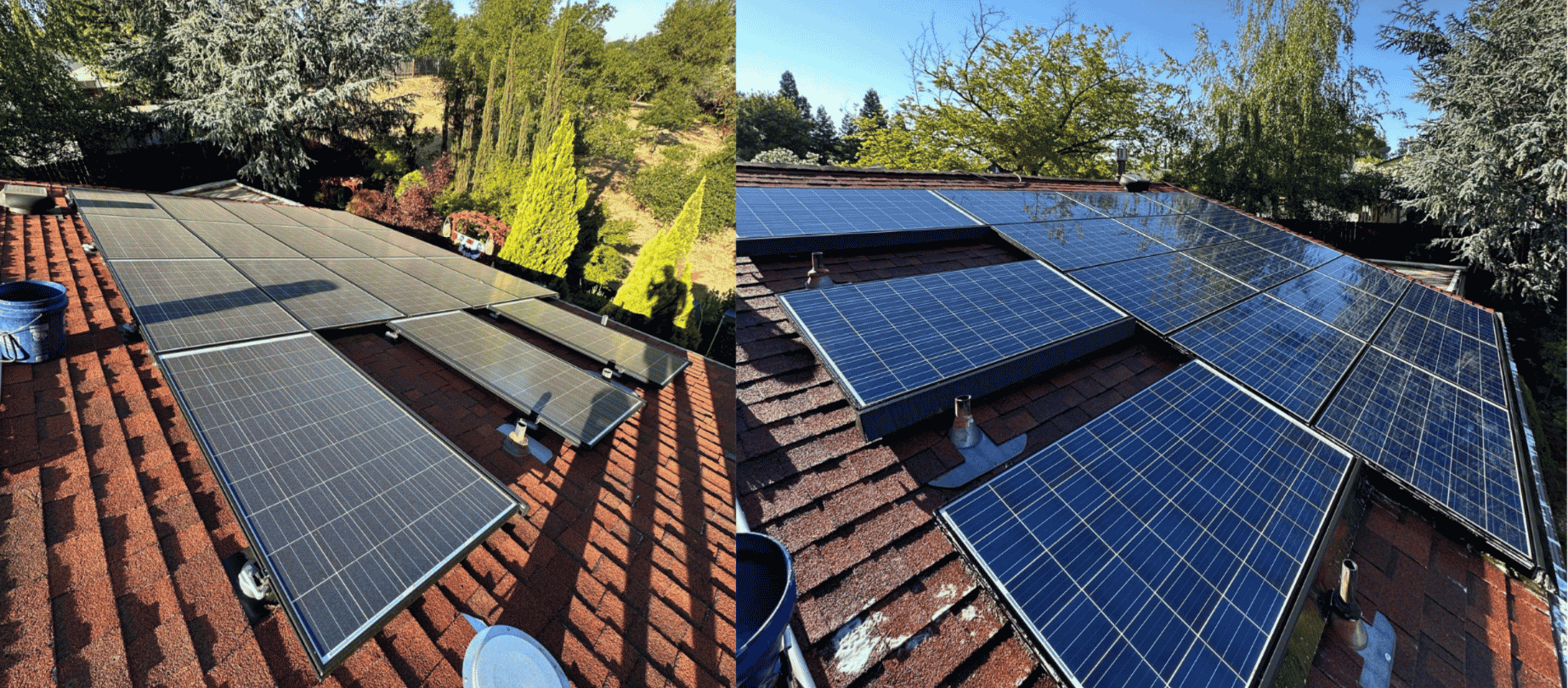
Spring pollen and fine dust settle early, and the long hot summer bakes them into a hard film. By late summer there’s no rain to soften it, so a hose rinse won’t cut it — lifting it without scratching the glass coating takes deionized water and a soft brush.
Fire-season ash and soot
On the valley’s eastern edge, wildfire ash and resinous soot drift in and settle on the glass. Left on hot panels, that film gets sticky and resists a plain rinse, which is why a cleaning after fire season matters here.
Sprinkler overspray and hard-water spotting
Panels within reach of lawn sprinklers pick up mineral spotting when hard water dries on hot glass. This is best prevented, not removed: keeping spray off the panels and cleaning on a regular schedule stops the minerals from setting in. Spots left to bake on over several summers can etch the glass permanently.
Big Arrays, Bigger Stakes in Folsom & El Dorado Hills
Homes in this area carry some of the largest rooftop solar arrays we clean anywhere in the region. Between the big roofs of El Dorado Hills and the solar-heavy subdivisions of Folsom, thirty- and forty-panel systems are common, and they’re usually the whole reason the home has such a low power bill.
That scale changes the math on cleaning. A soiling loss doesn’t hit one or two panels — it hits every panel on the roof at once. A film that shaves a modest slice off each panel adds up quickly across a large array, and because the panels are wired into strings, a few heavily soiled panels can drag down the output of the ones around them. The bigger the system, the more a season of baked-on dust quietly costs you.
The upside is that a big array is also where a cleaning pays off most. Clearing a full season of pollen, dust, and fire-season haze off a large system restores production across all of it at once, right as you head into the hottest, highest-demand months. On a system this size, keeping the glass clean isn’t cosmetic — it’s protecting the investment that’s carrying your energy bill.
How often should I clean my solar panels in Folsom or El Dorado Hills?
Twice a year suits most rooftops here — once in late spring after the pollen drops, and once in late summer or early fall once fire-season haze has settled. The long, hot, rainless summer is the reason: with almost no rain from June through September, nothing clears the panels on its own, and a large array can build up a meaningful soiling loss over that stretch.
Will hard water spots come off my panels?
Hard water spotting is best prevented, not removed. Fresh spotting from sprinkler overspray rinses off with regular service, but spots left to bake on over several summers can etch the glass and become permanent — and Sierra Vista Maintenance does not perform mineral or acid removal treatments. The fix is staying ahead of it: regular cleaning and keeping sprinkler spray off the panels keep the minerals from ever setting in.
Does a bigger solar array need cleaning more often?
Not necessarily more often, but it has more to lose. A soiling film hits every panel on the roof at once, so on a thirty- or forty-panel system the same light layer of dust adds up to more lost production than it would on a small array. Keeping a large system clean protects the output across all of it.
Do you clean commercial solar arrays in Folsom & El Dorado Hills?
Yes. Along with residential rooftops, we clean the larger roof- and ground-mounted arrays on businesses, office parks, and HOA facilities across Folsom, El Dorado Hills, and Cameron Park. The pure-water method is the same; we adjust for the scale and roof access of a commercial site.
Why do you use deionized water instead of just a garden hose?
Tap water here carries dissolved minerals. Spray it on hot panels and it dries into chalky spots that reflect light away from the cells and, left long enough, bake on for good. Deionized water has those minerals removed, so it rinses the glass clean and dries with no spots and no soapy film. A plain hose rinse can leave your panels worse off than before.
Request an Estimate
In most cases, we deliver same-day or next-day quotes after we speak with you on the phone or after you complete an estimate request online.