HVAC Air Duct Cleaning in Placerville & El Dorado County
Local Context
Placerville, Diamond Springs, Shingle Springs, and Rescue sit up in the Sierra foothills along the Highway 50 corridor, well above the valley floor. The housing is a mix of older homes, rural properties on acreage, and manufactured homes — many of them on raised foundations with crawlspaces and under-floor ductwork rather than attic runs.
The foothill climate runs to wider extremes than the valley: hot, dry summers and cold winters, with heavy wildfire-smoke exposure when fires burn in El Dorado County and the surrounding national forest. Homes run heating and cooling hard across the year.
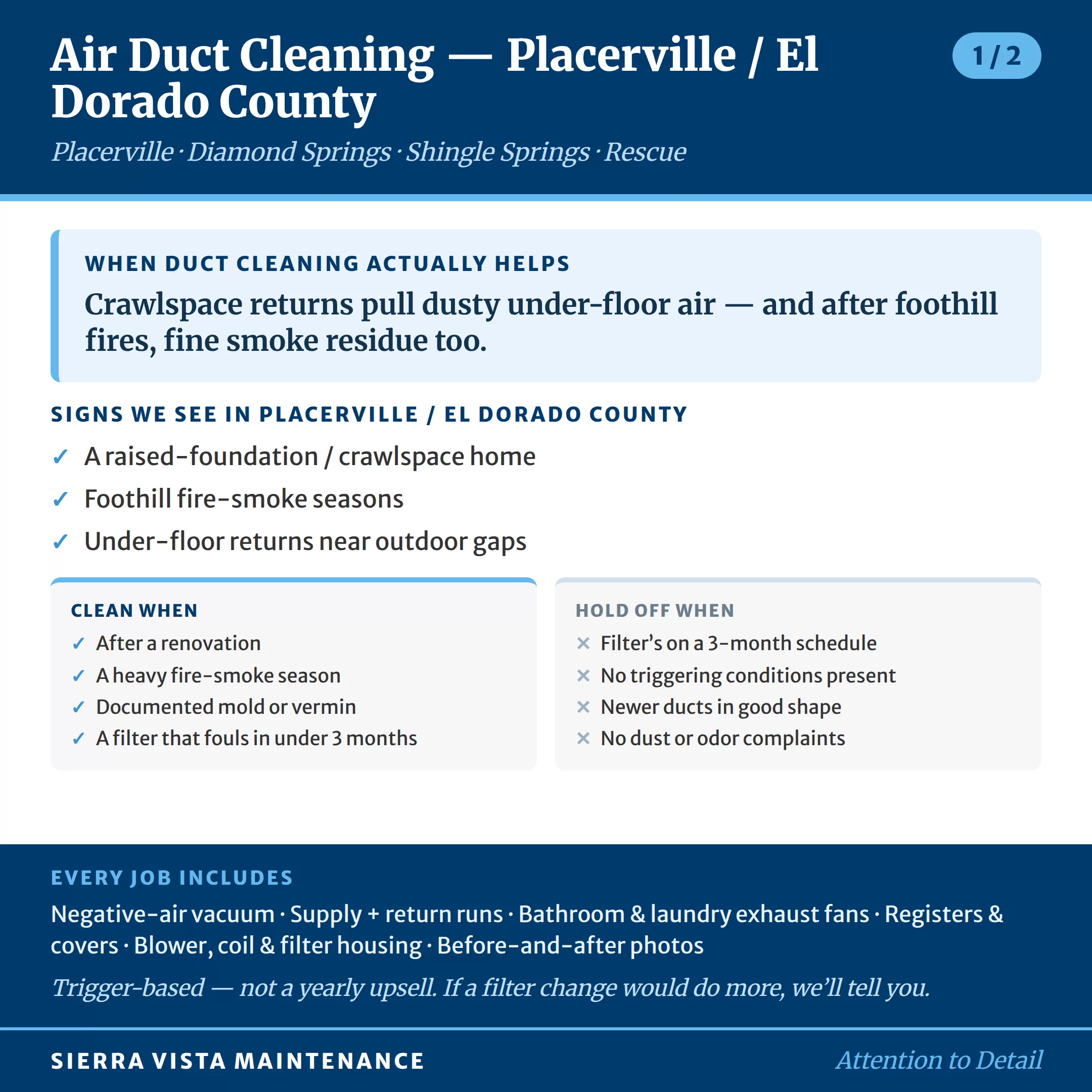
Duct cleaning is one of the most oversold services in home maintenance, and for most homes a filter change does more than a yearly cleaning would. But foothill and rural homes have a specific issue the valley suburbs mostly do not: rodents getting into under-floor ductwork. That is one of the conditions where cleaning is genuinely warranted.
How We Help Placerville & El Dorado County Homes & Businesses
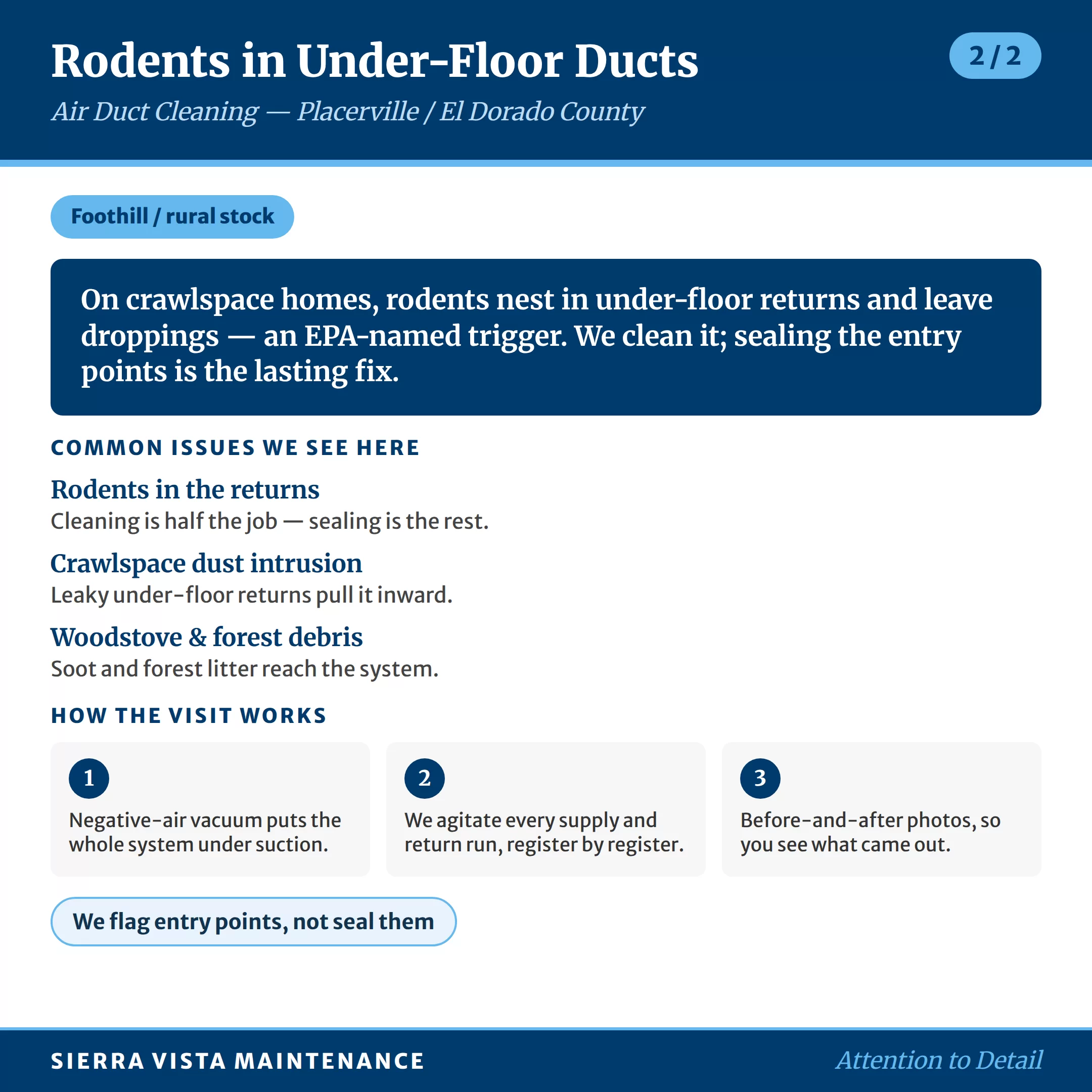
When duct cleaning is the right call, here is what the work involves. We connect a negative-air vacuum to the trunk line so the whole network is under suction — anything we loosen gets pulled out, not blown into your rooms. Then we work register by register, using air whips, brushes, or rotary heads suited to your duct material to clear the supply and return runs.
Every job covers the supply ducts through each register, the return ducts through each return grille, the bathroom and laundry-room exhaust fans, and the vent covers and registers. On crawlspace homes that includes the under-floor return runs where they are accessible. We document the work with before-and-after photos, so you can see what came out instead of taking our word for it.
Sierra Vista Maintenance has cleaned ducts across Placerville and El Dorado County since 2010. A typical home takes two to four hours depending on system size and condition. We protect floors and surfaces while we work. Sanitizing is a chemical step we add only with documented mold or after a rodent cleanout where it is warranted. And if the real fix is sealing the entry points rodents are using, we will tell you that, because cleaning the ducts without closing the gap just resets the clock.
What Makes Air Duct Cleaning in Placerville & El Dorado County Different
This is foothill country, and the climate is noticeably different from the valley floor an hour west. Placerville sits well above Sacramento in elevation, and the towns climb higher from there along Highway 50. Summers are hot and dry, winters are genuinely cold, and homes work both their heating and cooling through bigger seasonal swings than valley homes ever see.
Two foothill factors shape duct work here. The first is wildfire smoke. El Dorado County sees heavy smoke when fires burn in the surrounding national forest, and after a serious smoke season fine particulate settles through the filter, blower, and supply trunk — one of the EPA-recognized reasons a duct cleaning genuinely helps.
The second is the building style. Unlike the slab-on-grade tract homes down in the valley, a lot of foothill and rural housing sits on raised foundations with crawlspaces, and the ductwork — especially the returns — runs under the floor rather than through the attic. That puts the ducts in the same space as whatever else lives under the house. It is a more exposed environment, and it is the reason rodents end up in the system far more often here than they do in a closed valley subdivision. We weigh the smoke history and the crawlspace layout together with what we find inside, rather than assuming foothill living means your ducts are due.
Common Air Duct Cleaning Issues We See in Placerville & El Dorado County
A few patterns repeat on jobs across the foothills.
Rodents in under-floor ducts. On crawlspace homes, mice and rats nest in the return runs and leave droppings and debris. This is a legitimate trigger for cleaning — but the lasting fix is sealing the entry points, which is outside our scope.
Crawlspace dust intrusion. Under-floor returns that have loosened at a seam pull dusty crawlspace air into the system, which keeps a home feeling dusty no matter how often the filter is changed.
Smoke residue. After a heavy fire-smoke season in El Dorado County, fine particulate settles through the filter, blower, and supply trunk. Cleaning the ducts and replacing the filter together gives the system a reset.
Older insulation. In foothill homes built before 1980, duct insulation can be the white, papery wrap that may contain asbestos. We do not disturb it — if we suspect asbestos, we stop and refer you to a licensed remediation contractor first.
Rodents and Under-Floor Return Ducts in Foothill Homes
The trigger we see most in Placerville and the surrounding foothill towns is one the valley suburbs rarely deal with: rodents in the under-floor ductwork. On rural and crawlspace homes, it is common enough that we ask about it directly.
Here is why it happens. A lot of foothill homes sit on raised foundations, and the return ducts run under the floor through the crawlspace. That space is open to the outdoors in ways an attic is not, and to a mouse or rat a duct is a warm, sheltered tunnel. They get in, they nest, and they leave droppings and debris through the return runs — which then pull that material toward the air handler. A homeowner here described exactly this: under-floor return ducts holding a moderate amount of mouse droppings and dust that needed clearing out.
Vermin infestation is one of the specific conditions the EPA names for duct cleaning, so this is legitimate work, not an upsell. We clean out the affected runs and document what we find. But cleaning alone is only half the fix — if the rodents still have a way in, they come back. We will point out the entry points we can see and tell you plainly that sealing the crawlspace and controlling the rodents is the part that keeps it from recurring. That part is outside what we do, and we would rather you handle it than pay us to clean the same ducts again next year.
If you have crawlspace ductwork and any sign of rodents under the house, get on the phone with us and we will walk through what cleaning will and will not solve.

How often should I have my air ducts cleaned in Placerville?
There is no fixed schedule, and we do not recommend annual cleaning. The EPA recommends duct cleaning for specific conditions — visible mold, vermin, registers discharging debris, recent renovation, or after a heavy fire-smoke season — not as routine maintenance. In the foothills, the two that come up most are rodents in under-floor ducts and heavy wildfire smoke.
There are mouse droppings in my under-floor ducts. Can you clean that out?
Yes — rodent infestation is one of the conditions the EPA names for duct cleaning, and on crawlspace homes it is common. We clean out the affected return runs and document what we find. But cleaning alone is only half the fix: if the rodents still have a way in, they come back. We will point out the entry points and tell you plainly that sealing them is what keeps it from recurring.
Do you seal up where the rodents are getting in?
No, that part is outside what we do. We clean the ducts and show you the entry points we can see, but sealing the crawlspace and controlling the rodents is work for a pest-control or exclusion contractor. We are upfront about that because cleaning the ducts without closing the gap just resets the clock — we would rather you fix the cause than pay us twice.
My home was built before 1980 and has white-wrapped duct insulation — can you clean it?
Possibly not. White, papery insulation on pre-1980 ducts can contain asbestos, which cannot be cleaned, cut into, or disturbed without licensed remediation. Older foothill homes are exactly where this comes up. If we suspect that is what we are seeing when we arrive, we stop the job and refer you to a remediation contractor first.
What is the difference between duct cleaning and sanitizing?
Cleaning is mechanical — we use negative-air vacuum equipment and agitation tools to physically remove debris from inside the ducts. Sanitizing is a chemical treatment applied afterward. We do not push sanitizing as a default. After a rodent cleanout or with documented mold it can make sense; for a normal dusty system, cleaning alone is enough.
Request an Estimate
In most cases, we deliver same-day or next-day quotes after we speak with you on the phone or after you complete an estimate request online.