Driveway Cleaning in Placerville & El Dorado County
Local Context
Up the Highway 50 corridor into El Dorado County, Placerville, Shingle Springs, and Diamond Springs sit higher, cooler, and greener than the valley floor, under a heavy mix of pine, cedar, and oak. The lots run large and semi-rural, the driveways run long — often winding a hundred feet or more from a country road up to the house — and a lot of them spend most of the day in deep shade. Many of these properties are on well water rather than city water.
That elevation, canopy, and damp create a very different driveway than anything in the valley. The constant drop of pine needles and oak leaves leaves tannin shadows and organic staining, and the long shaded, north-facing stretches that never fully dry out grow moss and a slick biofilm. On a rural driveway that’s the main event — not baked-on dust or oil, but the green, organic buildup of a wet, wooded, shaded run of concrete.
Those long shaded driveways are a safety matter as much as an appearance one, because moss and biofilm get genuinely slippery once the rains start. Demand climbs heading into fall and the wet season, when the slick film is at its worst and homeowners want it gone before the first storms. Long private drives, gate codes, and spotty cell service are all part of the routine up here, so a little coordination before we arrive keeps a rural job running smoothly. Learn more about our driveway cleaning service.
How We Help Placerville & El Dorado County Homes & Businesses
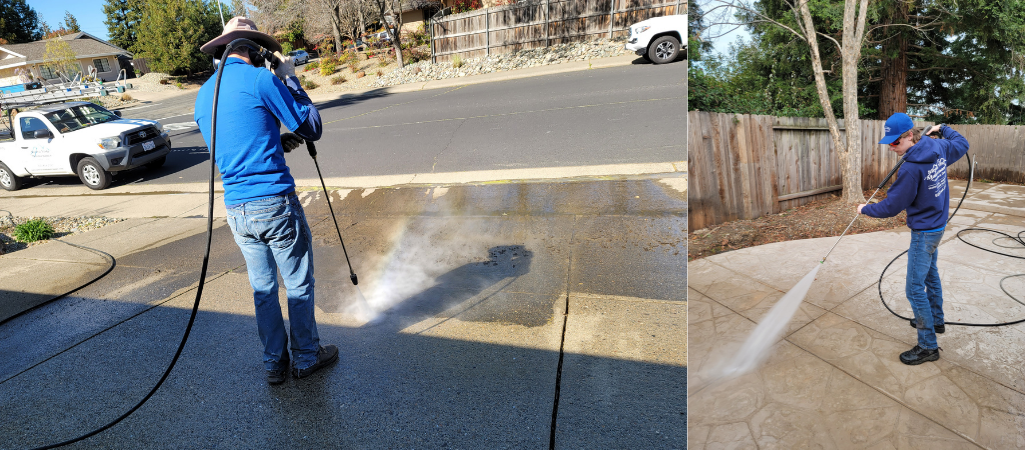
Every driveway we clean gets the same coverage: the body of the slab, the expansion joints, the garage approach pad, and the apron. In El Dorado County that often means a much longer run than a suburban driveway, with more linear footage of edge and joint to hand-finish after the surface-cleaner pass, and sometimes transitions between concrete, exposed aggregate, and a gravel or paver section along the way.
The key move up here is the soft-wash. Moss and biofilm can’t simply be blasted off — high pressure spreads the spores and chews at the concrete while the growth comes right back. Instead we treat the surface with a sodium-hypochlorite soft-wash that kills the moss and biofilm at the root, then clean and rinse. We pre-treat pine-needle and oak tannin staining with oxalic acid and lift oil with a degreaser where those show up, but the organic growth is the headline job on a rural, shaded driveway. We plan where the truck stages and how far we’re running hose before we start, since these driveways often sit well off the road and on grade.
We clean driveways for homes and for small-commercial and rural properties across the area, and we send photos when the job is done. We’re straight about what a wash will and won’t do: we clean concrete — we don’t reseal, restain, resurface, or repair it. Moss, tannin, and biofilm come off cleanly; a decade-old oil stain may lighten but won’t always disappear, and a wash won’t mend concrete that roots or grade have cracked. You’ll hear that before we start, not after.


What Makes Driveway Cleaning in Placerville & El Dorado County Different
Rural foothill driveways are simply a bigger, more varied job than valley ones. On these large lots a driveway can run well over a hundred feet, change grade as it climbs to the house, wind around mature trees, and transition between broom-finished concrete, exposed aggregate, and a gravel or paver apron. That’s far more surface to cover, and several different surfaces to read and adjust to, than a compact suburban slab.
The length and the setting change how we plan the whole job. We walk the entire run with you first and note where the canopy keeps sections permanently damp and mossy, where grade sends water and debris washing down, where a surface changes, and where roots or age have lifted the concrete. Then we work it in sections — soft-washing the shaded, moss-heavy stretches, surface-cleaning the open concrete, and hand-finishing the long edges and joints — adjusting pressure and technique as the surface changes down the run.
Access and water are part of it too. Many of these properties sit well off the road, on a slope, or past a gate, and a good number are on well water, so we plan staging, hose runs, and water use before we start rather than discovering them mid-job. And the honest read holds: a long, damp, mossy driveway comes back dramatically once the growth is killed and cleaned off, but weathered or root-lifted rural concrete won’t be made new by a wash, and we’ll say which is which up front.
Common Driveway Cleaning Issues We See in Placerville & El Dorado County
Pine-shade moss and biofilm. The signature rural-foothill problem — moss and slick green growth on the long, damp, shaded stretches. A sodium-hypochlorite soft-wash kills it at the root instead of just rinsing the surface.
The slip hazard. That moss and biofilm turn a driveway genuinely slippery once the rains start, so clearing it is a safety job as much as an appearance one.
Pine-needle and oak tannin staining. The constant organic drop leaves tannin shadows on the concrete; oxalic pre-treatment and a soft-wash lift them, though they re-leach as the trees keep dropping.
Length, grade, and mixed surfaces. Long runs, changing grade, and transitions between concrete, aggregate, and gravel mean more edge and joint work, which we plan and price around up front.
Root-lifted and grade-cracked concrete. Rural driveways shift with roots and slope over the years; not something a wash repairs, but something we flag and work carefully around.
Well-water iron staining. On properties on well water, iron can leave orange staining where irrigation hits the concrete; we spot-treat it with oxalic acid, the same chemistry that handles the tannin.
Long, Rural & Under the Pines
The problem that brings most El Dorado County homeowners to us isn’t a stain — it’s a long, shaded driveway going green. Under the pine and cedar canopy, on the north-facing and permanently shaded stretches that never quite dry out, moss and biofilm build up in the damp. It creeps along the joints and edges, spreads across the low, wet sections, and then the first rains of the season turn the whole run slick and genuinely hazardous to walk and drive on.
You can’t pressure-blast moss and biofilm away — that just scatters the spores and pits the concrete while the growth comes right back within a season. The fix is a sodium-hypochlorite soft-wash that kills the moss and biofilm at the root, followed by a clean and rinse, plus an oxalic pre-treatment on the pine-needle and oak tannin staining that shadows the concrete. Done right, it doesn’t just green-strip the driveway; it takes the slickness off a surface a rural family uses every single day.
Because the shade and damp that drive the growth aren’t going anywhere, and because these runs are long, we plan the work around the property — where we stage, how we handle a hundred-foot run on grade, and when to time it. Most rural foothill driveways do best on an annual soft-wash set ahead of the wet season, so the moss and the slip hazard never get the chance to fully establish before the storms arrive.
For a property owner, the payoff is a driveway that’s safe to walk and drive from the first storm through the last — on a long, shaded run that would otherwise stay green and slick for the whole wet season.
How often should I clean my rural driveway in Placerville or El Dorado County?
Most rural foothill driveways do best on an annual soft-wash, timed ahead of the wet season. The pine, cedar, and oak canopy and the deep shade keep growing moss and biofilm year after year, so staying on a yearly cadence keeps the slick film — and the slip hazard — from establishing.
My long driveway goes green and slippery every winter. Can you fix that?
Yes — that green is moss and biofilm growing in the shade and damp. We kill it at the root with a sodium-hypochlorite soft-wash rather than blasting it, which takes the slip hazard off the whole run, not just the green color, and keeps it from spreading back as fast.
Can you get the oil stains out of my driveway?
We pre-treat oil and engine drips with a degreaser and they usually lighten, but we can’t promise full removal. Getting oil completely out of concrete takes heavy chemical treatment we don’t perform, so on older, soaked-in stains we’re honest up front about what a wash will and won’t lift.
Will hard water spots come off my driveway?
Hard water spots are mineral deposits left behind when sprinkler or hose water dries on the concrete. Sierra Vista Maintenance does not perform acid or mineral-removal treatments, so we can’t guarantee existing spots will come off — our focus is preventing them by keeping sprinkler overspray off the slab and rinsing before the minerals bake in.
My driveway is really long and partly gravel. Can you still clean it?
Yes — long, mixed-surface rural driveways are most of what we clean up here. We walk the whole run with you first, soft-wash the shaded concrete stretches, surface-clean the open sections, and plan staging and hose runs around a property that may sit well off the road or on grade.
Request an Estimate
In most cases, we deliver same-day or next-day quotes after we speak with you on the phone or after you complete an estimate request online.