
Pressure Washing in Placerville & El Dorado County
Local Context
Placerville and the surrounding El Dorado County communities — Diamond Springs, Shingle Springs, and Rescue — sit along the Highway 50 corridor east of El Dorado Hills, in the Sierra foothills above the Apple Hill agricultural belt. This is rural and semi-rural country: larger wooded lots, mixed pine and oak, well-and-septic properties, and a mix of older Gold Rush-era and newer custom homes spread across hilly terrain.
Two features shape the cleaning work here. First, many properties are on private wells rather than treated municipal water, and foothill well water often carries iron and hard minerals that leave staining on the surfaces it touches. Second, the foothill setting is wet and shaded for much of the year — more rainfall than the valley, dense tree cover, and north-facing slopes that stay damp — which grows moss and algae on houses, roofs, and hardscape.
Because homes here are spread out and surfaces stay damp and shaded, pressure washing in Placerville and El Dorado County — many rural homeowners simply call it power washing — often means cleaning the whole house and its surroundings rather than a single driveway. Pressure washing, patio cleaning, and fence, deck, and trash-can cleaning are commonly quoted together.
How We Help Placerville & El Dorado County Homes & Businesses
Sierra Vista Maintenance cleans concrete, pavers, wood, and other exterior surfaces using pressure washing and soft-washing techniques. We do not repair, reseal, restain, or replace the surfaces we clean. If your concrete is spalled, your pavers are heaving, or your deck wood needs refinishing, we’ll tell you on the estimate so you can address the underlying issue with the right contractor.
Pressure Washing in Placerville & El Dorado County
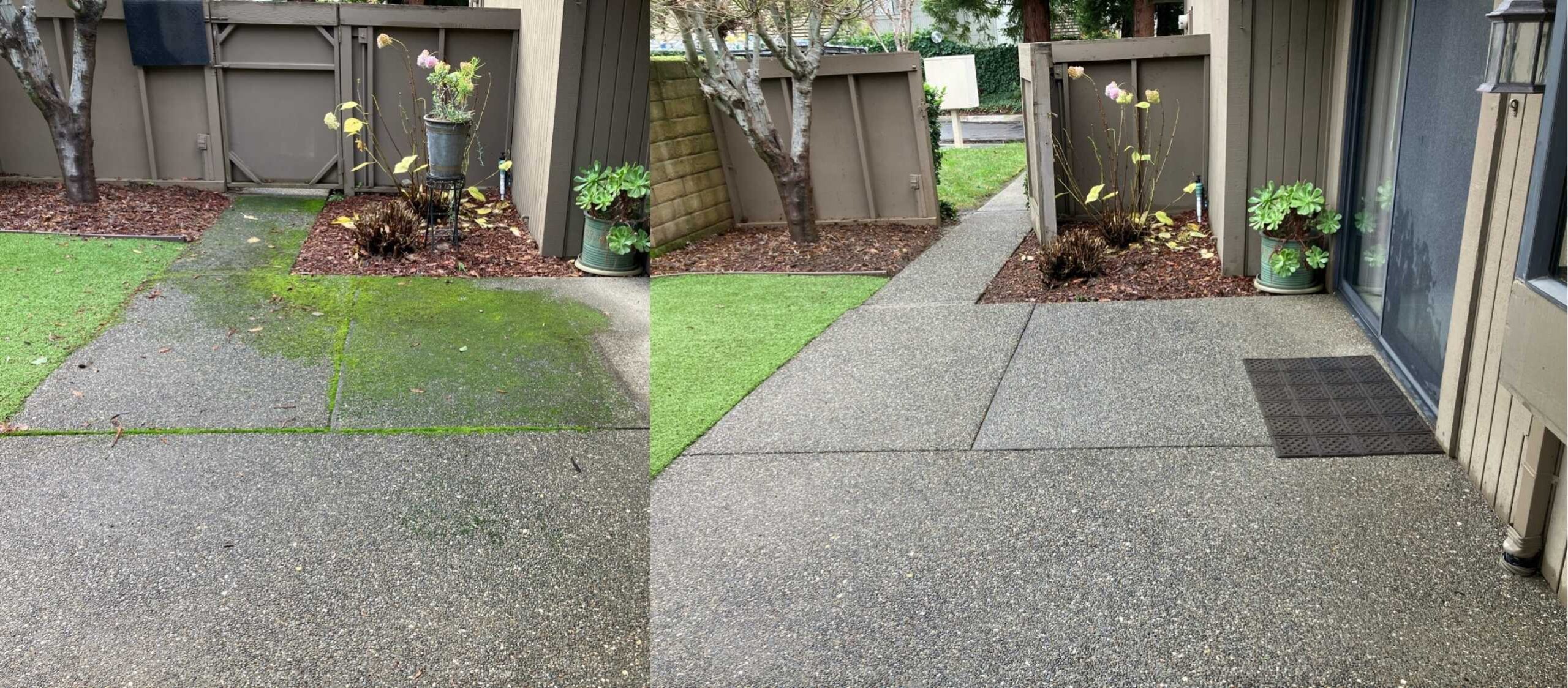
Concrete and hardscape across Placerville and El Dorado County — driveways, walkways, and patios — collect organic growth in the damp foothill shade and mineral staining where well water hits them. We run a surface cleaner where the concrete can take it and pre-treat first: an oxalic-acid product on iron and rust staining, a soft-wash detergent on moss and algae. We give you an honest read on what will fully clean and what will only lighten.
Natural stone, flagstone, and the older surfaces common on foothill properties get reduced pressure matched to the material.
Learn more about our pressure washing service.
Patio Cleaning in Placerville & El Dorado County
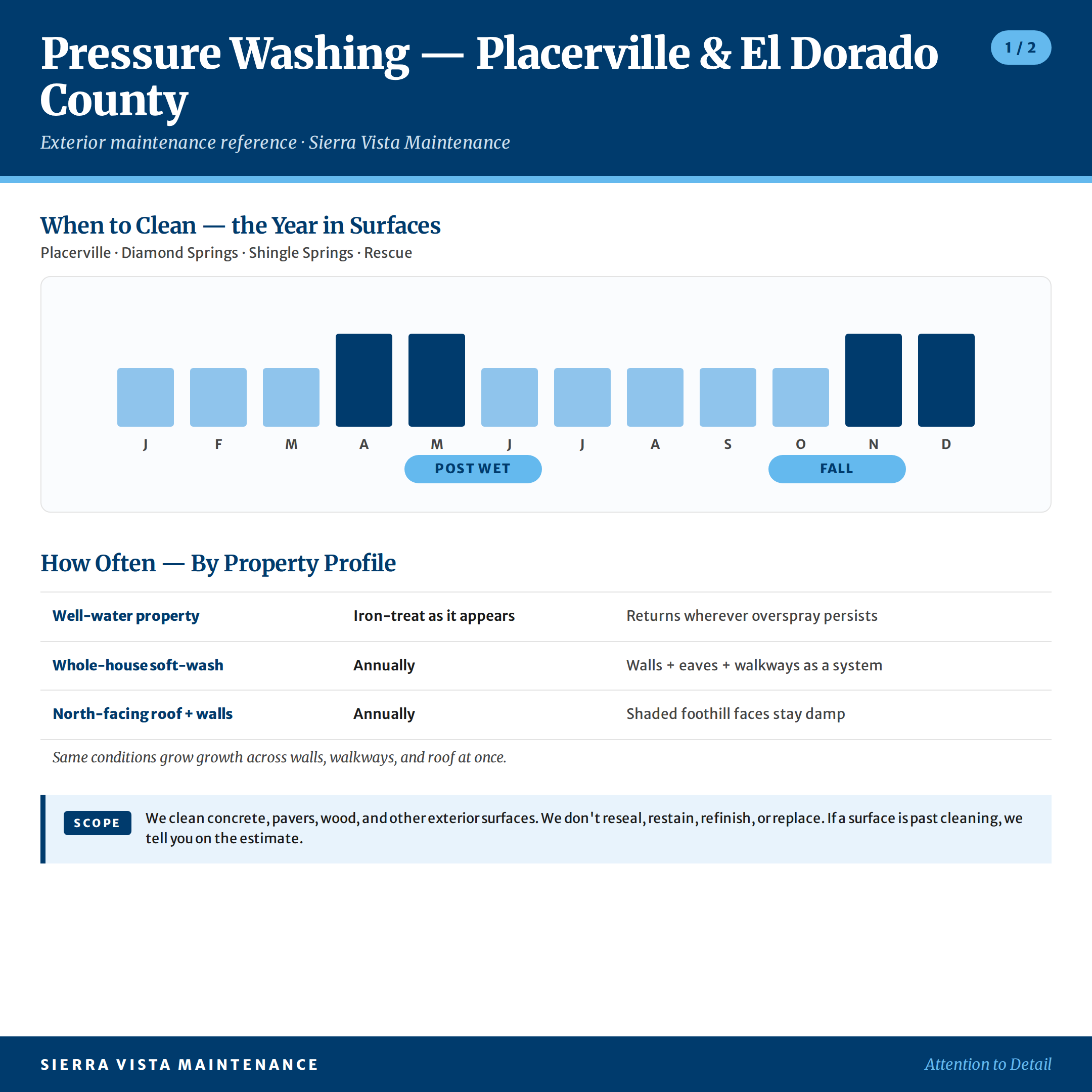
Patios and walkways on these wooded lots stay shaded and damp, so moss and biofilm are the main problem rather than baked-on dirt. Broom-finish and aggregate concrete take a surface cleaner; flagstone and natural stone get lower pressure; shaded mossy sections get a soft-wash detergent with dwell time. Iron staining from well-fed irrigation gets an oxalic-acid pre-treatment.
Spring is the right window after the wet season, before summer.
Learn more about our patio cleaning service.
Fence, Deck & Trash Can Cleaning in Placerville & El Dorado County
Wood fences and deck boards in the damp, shaded foothills gray and grow moss quickly. We soft-wash wood at low pressure with a biodegradable detergent that lifts the growth and weathering without raising the grain, and rinse trash cans and pads where buildup has set in.
We clean these surfaces; we don’t restain, reseal, or refinish them. If a surface is past cleaning, we’ll tell you on the estimate.
What Makes Pressure Washing in Placerville & El Dorado County Different
What makes pressure washing in Placerville and El Dorado County different is the water itself. Many properties out here, especially in Diamond Springs, Shingle Springs, Rescue, and the rural stretches around Placerville, are on private wells rather than treated municipal supply. Foothill well water frequently carries dissolved iron and hard minerals, and wherever that water touches an exterior surface — through an irrigation head, a hose bib, a sprinkler, or runoff — it leaves a mineral signature behind.
The most visible result is iron staining: an orange-brown discoloration on concrete, stucco, walkways, and the lower walls of buildings where iron-bearing well water sprays or splashes repeatedly. Hard-water mineral spotting shows up on the same surfaces from overspray and evaporation. These aren’t dirt sitting on top of the surface, so they don’t respond to a straightforward wash — pressure alone won’t lift iron staining, and scrubbing harder just risks damaging the surface without touching the mineral.
The right approach is chemistry matched to the stain. An oxalic-acid-based treatment lifts iron and mineral staining without etching the concrete or stucco underneath, which is the difference between a clean surface and a marked one. And because the well water keeps coming, the staining returns wherever the overspray continues — so part of the job is identifying where iron-bearing water is hitting the hardscape and the walls, so a homeowner can adjust an irrigation head or redirect a downspout and slow the return rather than cleaning the same stain on the same schedule forever.
Common Pressure Washing Issues We See in Placerville & El Dorado County
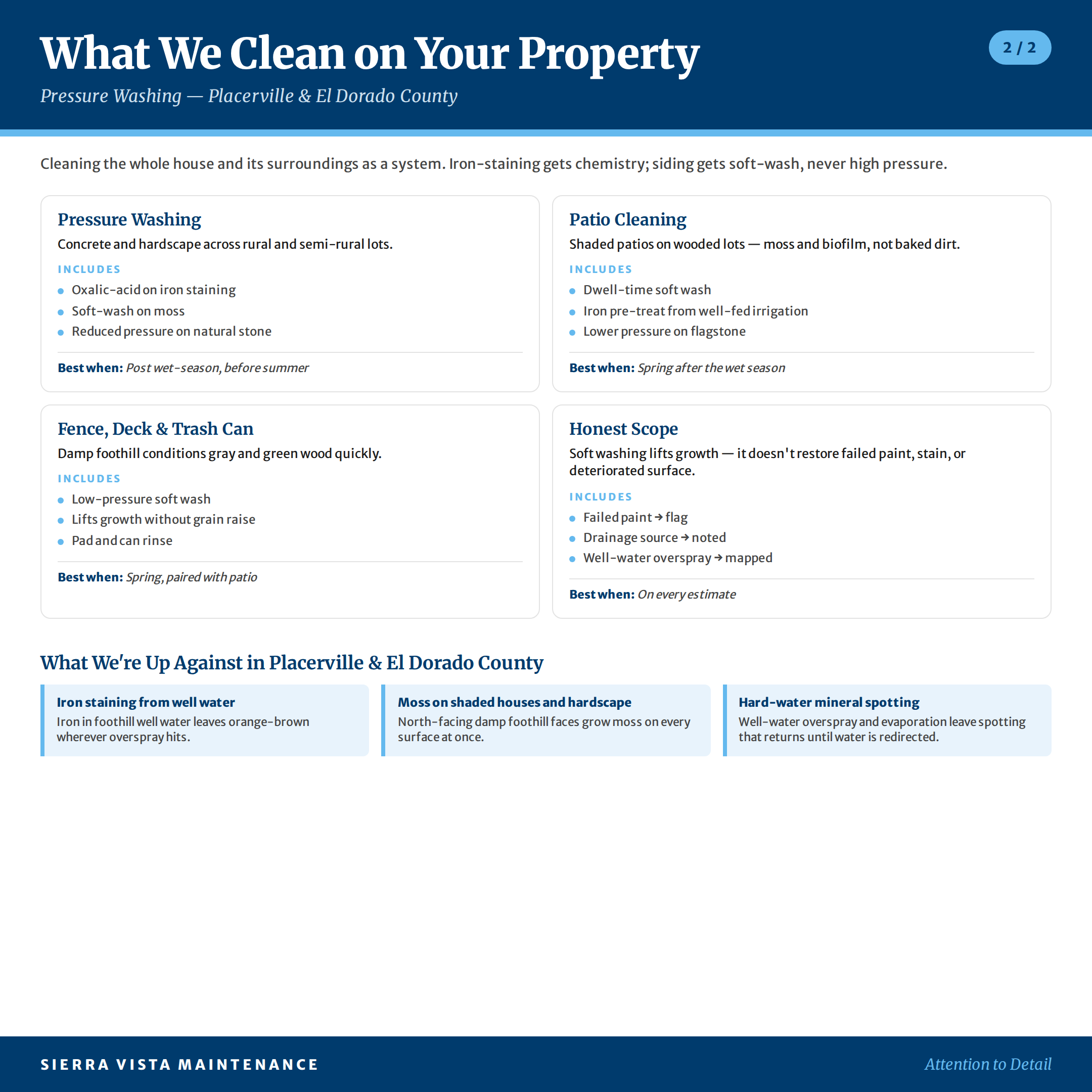
Iron staining from well water
Iron in foothill well water leaves orange-brown staining on concrete, stucco, and walls where irrigation or splashback hits repeatedly. An oxalic-acid treatment lifts it without etching; it returns wherever the iron-bearing water keeps landing.
Moss on shaded houses and hardscape
Damp foothill shade grows moss on north-facing siding, roofs, walkways, and patios. A soft-wash detergent kills it at the root; high pressure leaves the root and damages siding.
Hard-water mineral spotting
Well-water overspray and evaporation leave mineral spotting on hardscape and walls. It cleans up but returns with continued overspray; redirecting the water is the long-term fix.
Algae and biofilm on damp walkways
Shaded walkways through wooded lots grow algae that gets slick. A soft-wash detergent kills the growth before we rinse.
Whole-House Soft-Washing for Shaded Foothill Homes
On a shaded El Dorado County lot, the problem is rarely confined to one surface. The same damp, north-facing conditions that grow moss on the roof grow algae on the siding, biofilm on the walkways, and green film on the lower walls — so the most useful service for many foothill homes isn’t a driveway cleaning, it’s a soft wash of the whole house and its surroundings. Whether the call comes in as pressure washing or power washing, soft washing is the right method for a house exterior because siding, stucco, and trim can’t take high pressure without damage; the cleaning is done by a biodegradable detergent that breaks down the organic growth, with a low-pressure rinse carrying it away.
Whole-house soft washing works as a system. The growth on the north wall, the shaded eaves, the entry walkway, and the patio all trace back to the same shade and moisture, and all respond to the same detergent approach, so treating them together is more efficient and more durable than cleaning one surface while the untreated ones keep re-seeding it. On a wooded foothill property, cleaning the walkway while moss continues washing down off an untreated roof just re-stains what you cleaned — addressing the house as a whole avoids that.
Because these properties are rural and spread out, we plan the visit around the full scope: the house faces, the shaded eaves and trim, the walkways and patio, and the well-water iron staining wherever it appears, each with the right technique. We’re honest about what soft washing does and doesn’t do — it lifts growth and grime but doesn’t restore failed paint, stain, or a surface that’s deteriorated past cleaning — so if something needs more than a wash, we’ll flag it on the estimate. And we’ll point out where shade, drainage, or well-water overspray is driving the growth, so you can address the cause rather than only the symptom.
My house is on a well and has orange staining. Can you clean it?
Yes. Orange-brown staining from iron in well water lifts with an oxalic-acid treatment that doesn’t etch the concrete or stucco underneath. It returns wherever the iron-bearing water keeps landing, so we’ll help you identify the source so you can slow the return.
Is high pressure safe on my house siding and stucco?
No — the house exterior gets a low-pressure soft wash. Siding, stucco, and trim can’t take high pressure without damage. A biodegradable detergent breaks down the moss and algae, and a gentle rinse carries it away.
Why does moss keep growing back on the north side of my house?
Damp foothill shade is exactly what moss needs, and on a north-facing wall it’s a constant condition. A soft-wash detergent kills the growth at the root, which slows the return, but the shade and moisture mean it will eventually regrow — periodic cleaning keeps it in check.
Can you clean the whole house and surroundings in one visit?
On most foothill properties, yes — the house faces, eaves and trim, walkways, and patio in one visit, treated together because the growth on all of them traces back to the same shade and moisture. Cleaning them as a system is more durable than doing one surface at a time.
Will pressure washing remove well-water mineral spotting permanently?
The spotting cleans up, but it returns wherever well-water overspray or splashback keeps hitting the surface. Redirecting the irrigation or downspout away from the hardscape and walls is the long-term fix; we’ll show you where the water is landing.
Request an Estimate
In most cases, we deliver same-day or next-day quotes after we speak with you on the phone or after you complete an estimate request online.