Solar Panel Cleaning in Roseville, Rocklin & Granite Bay
Local Context
Roseville, Rocklin, and Granite Bay sit along the Interstate 80 corridor in southern Placer County, one of the fastest-growing parts of the Sacramento region. Roseville is the county’s largest city and its commercial anchor, home to the Westfield Galleria and a dense retail and office corridor; Rocklin grew up around its granite quarries; Granite Bay spreads out in larger lots toward Folsom Lake.
This is newer suburban territory, and much of it is still filling in. Master-planned neighborhoods like Whitney Ranch and Stanford Ranch keep adding rooftops, most of them built solar-ready or with panels already installed. Alongside the homes sits one of the region’s strongest commercial corridors, so both residential and commercial arrays are common here.
Summers are hot and dry. Sitting well inland from the Delta, this stretch of Placer County misses much of the afternoon cooling breeze, so rooftops run hot from June into September with essentially no rain to rinse them. Whatever settles on the glass in spring is still there in late summer.
Whether you own a home in Whitney Ranch or manage a property near the Galleria, that combination of hot rainless summers and a region still under construction is what makes regular solar panel cleaning worth scheduling here.
How We Help Roseville, Rocklin & Granite Bay Homes & Businesses
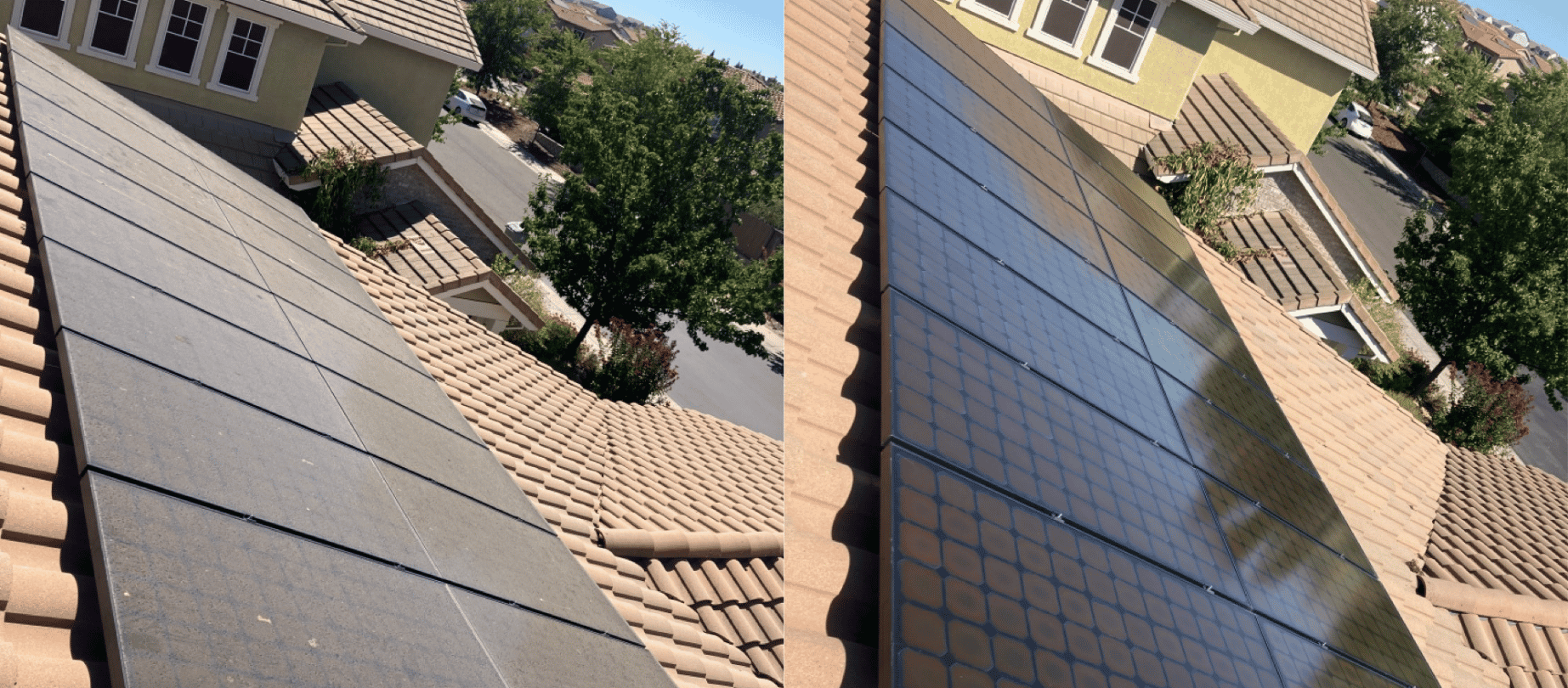
We clean rooftop solar arrays using pure, deionized water and soft-bristle tools on extension poles. Deionized water has had its minerals stripped out, so it lifts pollen, dust, and grime off the glass and then dries with no spots or streaks — no soap, and no residue left behind to attract the next layer of dust.
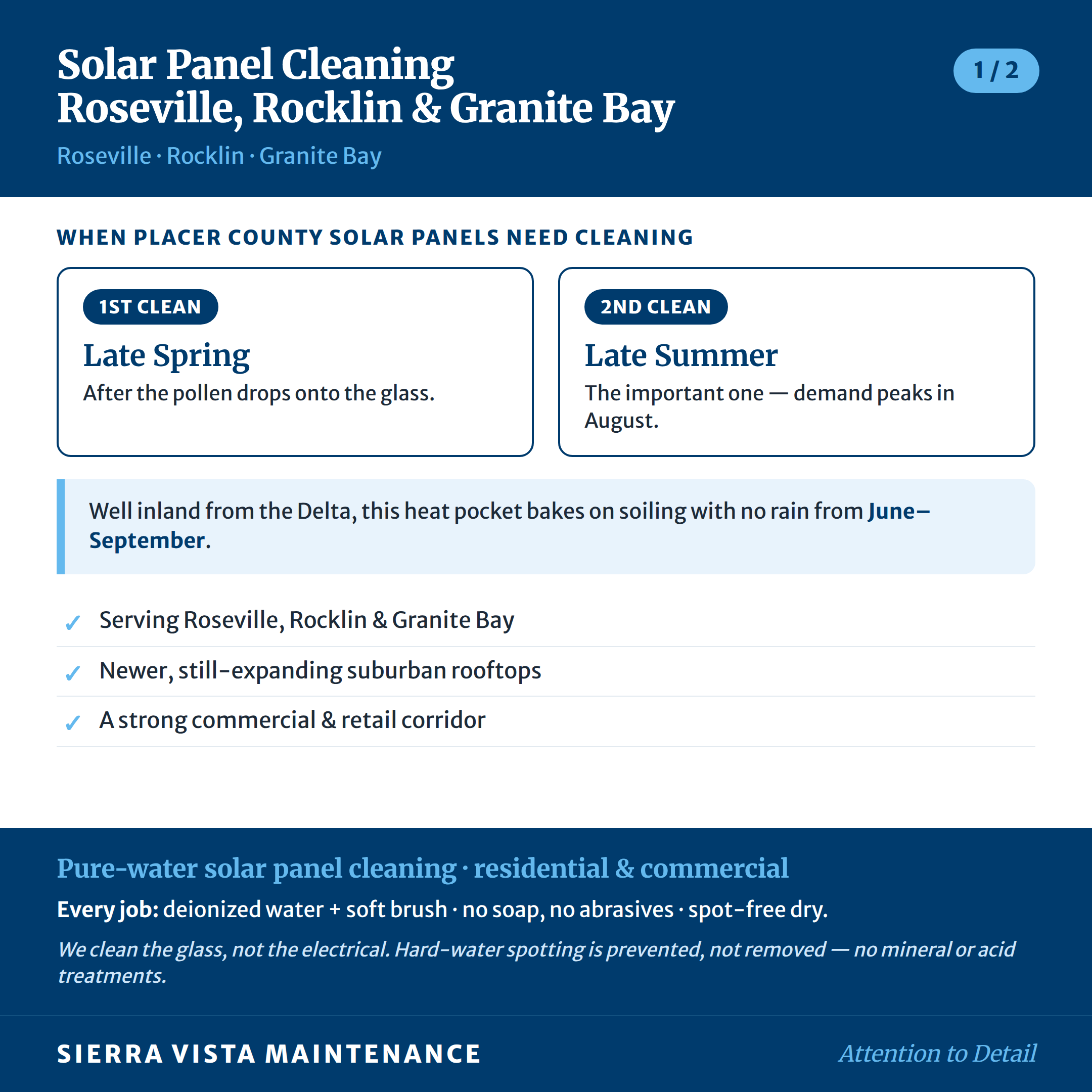
Most of our work here is residential. Our residential solar panel cleaning covers the rooftop arrays on homes across Roseville, Rocklin, and Granite Bay, where hot summers and construction dust do the most soiling. We time most cleanings for late spring, after the pollen drops, and again in late summer, so your panels head into the highest-production months clear.
We also clean commercial solar panel installations — the larger roof- and ground-mounted arrays on businesses, retail centers, and office parks along the Roseville and Rocklin commercial corridor. The pure-water method is the same; the scale and roof access are what change.
We clean the glass; we don’t service the electrical side of your system. If we spot a cracked panel, a loose clamp, or wiring that looks off while we’re up there, we’ll tell you so you can get the right person out to look at it.

What Makes Solar Panel Cleaning in Roseville, Rocklin & Granite Bay Different
What sets this area apart is heat without much relief. Roseville, Rocklin, and Granite Bay sit well inland from the Sacramento–San Joaquin Delta, so they lose most of the afternoon breeze that cools the valley floor to the south. On a hot Placer County afternoon, dark rooftop panels can run far above the surrounding air temperature.
That heat is what makes soiling stick. Loose dust and pollen that might blow off a cooler roof instead bake into a hard film on hot glass, and a plain rinse won’t lift it once it’s set. An isolated spot — a dropping, a clump of dust — can also heat up into a hot spot that the panel string has to work around, costing more output than its size suggests.
And because summers here run essentially rainless from June through September, nothing clears the glass on its own between spring and the winter rains. A full season of soiling accumulates and bakes on, which is why regular cleaning — not a hopeful wait for rain — is what keeps a Placer County array producing through the hottest months.
Common Solar Panel Cleaning Issues We See in Roseville, Rocklin & Granite Bay
Construction and road dust
With neighborhoods still going up across Rocklin and west Roseville, fine construction and road dust stays in the air and settles on nearby arrays. On hot glass it bakes into a gray film that a hose rinse won’t fully clear.
Baked-on summer soiling and hot spots
The heat-pocket summers bake pollen, dust, and droppings onto the glass. An isolated baked-on spot can become a hot spot that drags down the output of the panels wired around it.
Sprinkler overspray and hard-water spotting
Panels within reach of lawn sprinklers pick up mineral spotting when hard water dries on hot glass. This is best prevented, not removed: keeping spray off the panels and cleaning on a regular schedule stops the minerals from setting in. Spots left to bake on over several summers can etch the glass permanently.
Construction Dust in a Region That’s Still Building
Roseville, Rocklin, and Granite Bay have been among the fastest-growing communities in the region for years, and a lot of that growth is still happening. Master-planned neighborhoods like Whitney Ranch and Stanford Ranch are actively adding streets and rooftops, and where there’s construction, there’s dust.
Fine construction dust doesn’t stay put. Grading, framing, and road work throw up a steady haze of fine particulate that drifts with the wind and settles on whatever is nearby — including the solar panels on homes a few lots over. Unlike a heavy leaf or a dropping, this dust lands as a thin, even layer across the whole array, dulling every panel a little at once. It’s easy to miss from the ground and easy to underestimate.
The heat makes it worse. On hot Placer County glass, that fine dust bakes into a film that a rinse won’t lift, and it keeps building through the rainless summer. If your neighborhood is still filling in, or a new phase just broke ground nearby, it’s worth checking your panels more closely — construction dust is one of the quieter reasons a newer array underperforms here.
How often should I clean my solar panels in Roseville, Rocklin, or Granite Bay?
Twice a year works well for most rooftops here — once in late spring after the pollen drops, and once in late summer, which tends to be the important one. The heat-pocket summers run essentially rainless from June through September, so nothing clears the panels on their own, and if there’s active construction nearby you may want to check them more often.
Will hard water spots come off my panels?
Hard water spotting is best prevented, not removed. Fresh spotting from sprinkler overspray rinses off with regular service, but spots left to bake on over several summers can etch the glass and become permanent — and Sierra Vista Maintenance does not perform mineral or acid removal treatments. The fix is staying ahead of it: regular cleaning and keeping sprinkler spray off the panels keep the minerals from ever setting in.
Does nearby construction really affect my solar panels?
It can. Grading and building throw fine dust into the air that drifts and settles as a thin, even film across a whole array. On hot glass it bakes on, and because it dulls every panel a little at once, it’s easy to miss from the ground. If a new phase is going up near you, it’s worth a closer look.
Do you clean commercial solar arrays in Roseville, Rocklin & Granite Bay?
Yes. Along with residential rooftops, we clean the larger roof- and ground-mounted arrays on businesses, retail centers, and office parks across the Roseville and Rocklin corridor. The pure-water method is the same; we adjust for the scale and roof access of a commercial site.
Why do you use deionized water instead of just a garden hose?
Tap water here carries dissolved minerals. Spray it on hot panels and it dries into chalky spots that reflect light away from the cells and, left long enough, bake on for good. Deionized water has those minerals removed, so it rinses the glass clean and dries with no spots and no soapy film. A plain hose rinse can leave your panels worse off than before.
Request an Estimate
In most cases, we deliver same-day or next-day quotes after we speak with you on the phone or after you complete an estimate request online.